

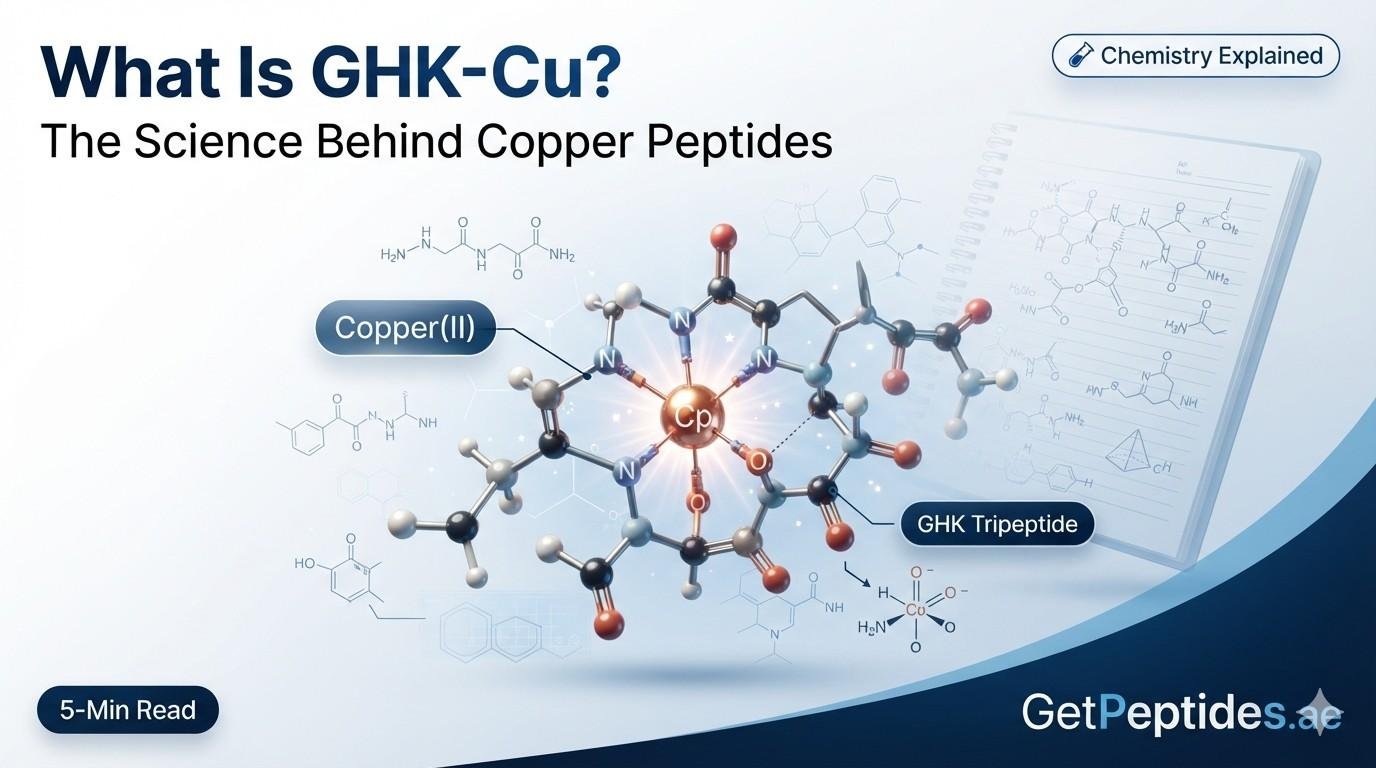
What Is GHK-Cu? – GHK-Cu is a copper-peptide coordination complex formed when the naturally occurring tripeptide GHK (Glycyl-L-Histidyl-L-Lysine) binds to a Copper(II) ion. Through a process called chelation, the peptide donates electron pairs from specific nitrogen and oxygen atoms, creating a stable metal–peptide complex. Researchers study this interaction because coordinated metal complexes often display chemical properties that differ from their individual components, making GHK-Cu an important example in coordination chemistry and analytical research.
Introduction
Have you ever wondered why GHK-Cu is called a copper peptide?
The answer lies in a fascinating branch of chemistry known as coordination chemistry, which explores how metal ions interact with molecules to form stable chemical complexes. Rather than existing as two separate substances, the small tripeptide GHK and a Copper(II) ion combine through carefully arranged coordination bonds to create a single molecular complex known as GHK-Cu.
This interaction has made GHK-Cu one of the most widely recognized examples of copper peptide coordination chemistry in scientific literature. Researchers use it to study fundamental principles such as ligand binding, chelation, molecular stability, and metal–peptide interactions. These concepts are important not only in inorganic chemistry but also in analytical chemistry, where understanding molecular structure helps scientists characterize compounds with greater precision.
In this article, we’ll explore the chemistry behind GHK-Cu from first principles—explaining what copper peptides are, how Copper(II) binds to the GHK tripeptide, why the resulting coordination complex behaves differently from the free peptide, and how modern laboratory techniques are used to analyze these molecular structures.
What Is Coordination Chemistry?
At its core, coordination chemistry is the study of how metal ions interact with surrounding molecules known as ligands.
Imagine a metal ion as the hub of a wheel. Around that hub, several molecules attach themselves like spokes, forming a highly organized structure. Instead of sharing electrons equally—as happens in many conventional chemical bonds—the surrounding molecules donate pairs of electrons to the metal center, creating what chemists call coordination bonds.
The resulting structure is known as a coordination complex.
Several key terms make this concept easier to understand:
- Metal Ion: A positively charged atom capable of accepting electron pairs. In GHK-Cu, this is Copper(II).
- Ligand: A molecule that donates electron pairs to a metal ion. The GHK tripeptide acts as the ligand.
- Coordination Bond: A bond formed when both electrons originate from the ligand rather than being shared equally between two atoms.
- Chelation: A special type of coordination where one ligand binds the same metal ion at multiple locations, creating a more stable complex.
- Donor Atoms: Atoms such as nitrogen or oxygen that provide the electron pairs needed for metal binding.
An everyday analogy is fastening a climbing harness. Instead of relying on a single attachment point, several straps connect securely around the body. Likewise, a chelating ligand anchors itself to a metal ion through multiple donor atoms, making the overall structure significantly more stable than a single-point attachment.
This ability to form stable, well-defined complexes is one reason coordination chemistry plays such a central role in analytical chemistry, biochemistry, and materials science.
Understanding the GHK Tripeptide
Before exploring how GHK-Cu forms, it’s helpful to understand the peptide itself.
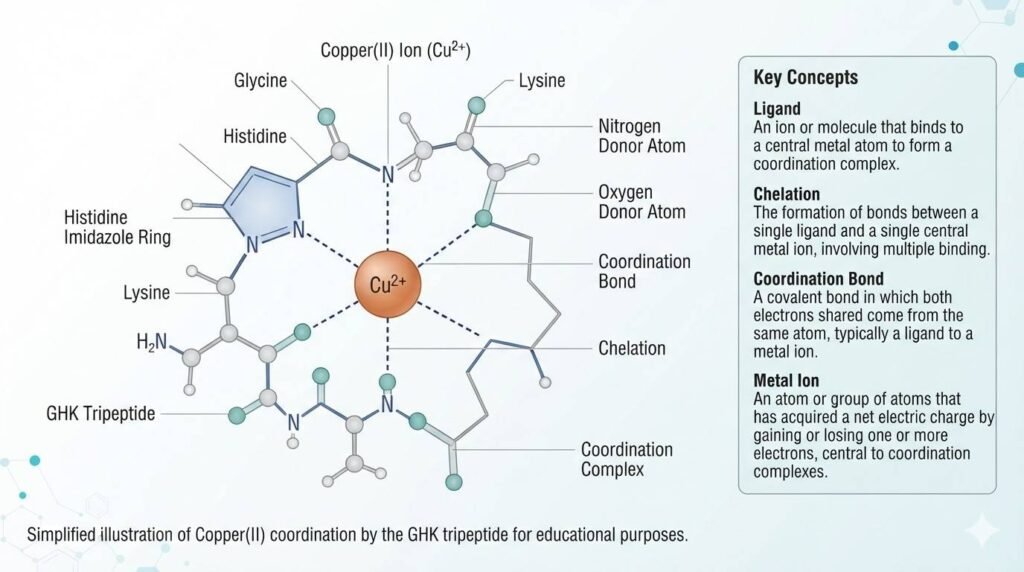
GHK is the abbreviation for the tripeptide Glycyl-L-Histidyl-L-Lysine. As its name suggests, it consists of three amino acids linked together by peptide bonds:
- Glycine (Gly) – the smallest amino acid, contributing structural flexibility.
- Histidine (His) – contains an imidazole ring that plays a crucial role in metal coordination.
- Lysine (Lys) – provides an amino side chain that can participate in molecular interactions and influence the overall geometry of the peptide.
Although each amino acid has its own chemical characteristics, histidine is the key player in copper binding. Its imidazole ring contains nitrogen atoms capable of donating electron pairs, making it an excellent ligand for transition metals such as Copper(II).
The peptide backbone also contributes to coordination. Depending on the molecular environment, oxygen atoms from peptide carbonyl groups and terminal amino groups may participate in stabilizing the metal complex. Rather than relying on a single attachment point, GHK surrounds the copper ion through multiple donor atoms, producing a more stable three-dimensional structure.
This multi-point attachment is one of the defining characteristics of chelation, a concept that frequently appears throughout coordination chemistry.
How Does GHK Bind Copper(II)?
The formation of GHK-Cu begins when the GHK peptide encounters a Copper(II) ion under suitable laboratory conditions. Instead of forming ordinary covalent bonds, the peptide establishes a network of coordination bonds, where electron pairs donated by the peptide are accepted by the metal ion.
From a structural perspective, the process can be visualized in three stages:
1. Recognition
Copper(II) approaches the peptide and interacts with available donor atoms, particularly the nitrogen atom within histidine’s imidazole ring.
2. Coordination
Additional donor atoms—including the terminal amino group and oxygen atoms from the peptide backbone—coordinate with the copper ion. These multiple interaction points effectively “wrap around” the metal center.
3. Stabilization
Once several coordination bonds are established, the molecule forms a chelated coordination complex. This arrangement is energetically more stable than a simple one-point interaction, helping maintain the integrity of the metal-peptide complex during analytical studies.
Unlike free GHK, the coordinated complex has a different electronic environment surrounding the copper ion. Chemists often describe this as a change in the molecule’s coordination geometry, which influences measurable properties such as spectroscopic behavior, molecular charge distribution, and overall structural stability.
Importantly, coordination chemistry focuses on how atoms interact, not on biological or cosmetic outcomes. For researchers, GHK-Cu serves as a valuable model for understanding the broader principles of metal–ligand chemistry and molecular design.
See a Laboratory Research Example
Now that you’ve learned how GHK-Cu forms a stable copper–peptide coordination complex, you may wish to explore how this molecule is presented as a laboratory research material.
Our GHK-Cu Skin Glow 30 mg page provides technical specifications, purity information, storage guidance, and product documentation intended for laboratory research.
Explore GHK-Cu Skin Glow 30 mg
Editorial Note: This link is provided for readers seeking additional technical information about the research material discussed in this article. The content is educational and does not constitute medical or therapeutic guidance.
Why Does the GHK-Cu Complex Behave Differently from Free GHK?
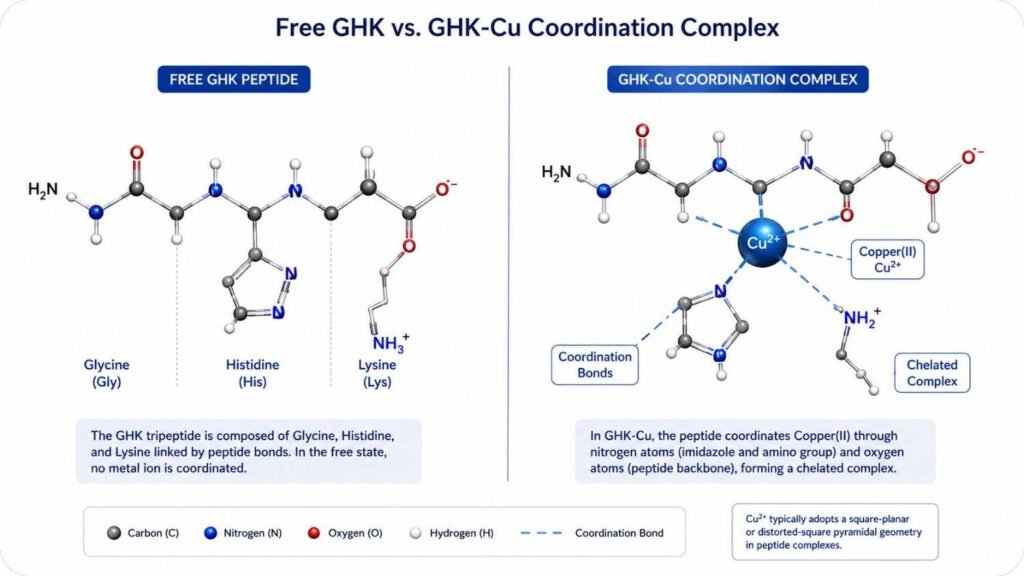
One of the most interesting aspects of copper peptide coordination chemistry is that a molecule can exhibit different chemical characteristics after forming a coordination complex. When GHK binds a Copper(II) ion, the resulting GHK-Cu complex is not simply a mixture of a peptide and a metal—it becomes a new molecular entity with its own structural and electronic properties.
Changes in Electronic Structure
Copper(II) contains partially filled electron orbitals that influence how electrons are distributed throughout the coordination complex. Once the GHK peptide donates electron pairs to the metal ion, the electronic environment surrounding both the peptide and copper changes.
From an analytical chemistry perspective, this altered electron distribution can affect how the complex interacts with light, magnetic fields, and other analytical instruments. Researchers often use these measurable differences to distinguish a coordinated complex from its individual components.
Increased Molecular Stability Through Chelation
Another defining feature of GHK-Cu is chelation.
Rather than attaching to Copper(II) through a single donor atom, the GHK peptide forms several coordination bonds simultaneously. This multi-point attachment creates a more stable coordination complex than would typically be achieved with a single-point interaction.
Chemists often refer to this phenomenon as the chelate effect, a well-established principle in coordination chemistry that explains why multidentate ligands generally produce more stable metal complexes.
This increased stability is one reason coordinated metal-peptide complexes are frequently used as model systems in inorganic and analytical chemistry research.
Charge Distribution and Molecular Geometry
Binding a metal ion also changes the overall geometry of the molecule.
Free GHK exists as a flexible tripeptide, while the coordinated GHK-Cu complex adopts a more organized three-dimensional arrangement around the Copper(II) center. This structural reorganization influences molecular charge distribution, bond angles, and the orientation of donor atoms.
Although these changes occur at the atomic level, they are essential for understanding how coordination complexes are characterized in laboratory settings.
Rather than focusing on biological activity, coordination chemistry asks a more fundamental question:
How does the structure of a molecule change when it binds a metal ion?
GHK-Cu provides an excellent educational example for exploring this concept.
How Do Scientists Measure Copper Content in GHK-Cu?
After synthesizing or studying a metal-peptide complex, researchers need reliable methods to verify its composition. Analytical chemistry provides several techniques for confirming the presence of Copper(II) and evaluating the characteristics of the coordination complex.
Inductively Coupled Plasma Mass Spectrometry (ICP-MS)
ICP-MS is one of the most sensitive techniques available for detecting trace amounts of metals.
The sample is converted into an ionized plasma, allowing the instrument to identify and quantify copper ions with extremely high sensitivity. Because of its precision, ICP-MS is widely used in research laboratories when measuring metal content in coordination compounds.
Atomic Absorption Spectroscopy (AAS)
Atomic Absorption Spectroscopy measures how copper atoms absorb light at characteristic wavelengths.
By comparing light absorption against calibration standards, researchers can determine the concentration of Copper(II) present in a sample. AAS remains a trusted analytical method for routine metal analysis due to its accuracy and reproducibility.
High-Performance Liquid Chromatography (HPLC)
Although HPLC is primarily associated with peptide analysis, it also plays an important role in evaluating sample composition.
Researchers use HPLC to examine chromatographic profiles, assess sample purity, and identify whether additional peptide-related components are present alongside the coordination complex.
UV–Visible Spectroscopy
Many coordination complexes absorb visible or ultraviolet light differently from their individual components.
By recording an absorption spectrum, scientists can observe characteristic changes that occur after Copper(II) coordinates with the peptide. These spectral differences help confirm complex formation and provide additional insight into the coordination environment.
Together, these analytical techniques allow researchers to characterize copper-peptide complexes with confidence, combining structural information with quantitative measurements to build a comprehensive understanding of molecular composition.
Comparison Table
| Feature | Free GHK Peptide | GHK-Cu Coordination Complex |
|---|---|---|
| Copper Bound | No | Yes (Copper(II)) |
| Molecular Form | Tripeptide | Metal–peptide coordination complex |
| Coordination Bonds | Not present | Multiple coordination bonds |
| Chelation | No | Yes |
| Electronic Environment | Native peptide | Altered by metal coordination |
| Typical Laboratory Analysis | HPLC, Mass Spectrometry | ICP-MS, AAS, UV–Vis, HPLC, Mass Spectrometry |
Continue Exploring Copper Peptide Chemistry
Understanding how GHK coordinates with Copper(II) provides valuable insight into the broader principles of coordination chemistry and analytical science.
If you’d like to explore a laboratory research example, visit our GHK-Cu Skin Glow 30 mg page for technical specifications, product documentation, and research-focused information.
Frequently Asked Questions
What is GHK-Cu?
GHK-Cu is a coordination complex formed when the tripeptide GHK (Glycyl-L-Histidyl-L-Lysine) binds to a Copper(II) ion. Through coordination bonds, the peptide acts as a ligand, creating a stable metal–peptide complex that is widely studied in coordination chemistry, analytical chemistry, and peptide research.
What is a copper peptide?
A copper peptide is a peptide molecule that forms a coordination complex with a copper ion. The peptide provides donor atoms—typically nitrogen or oxygen—that donate electron pairs to the metal center. The resulting complex exhibits structural and electronic properties that differ from the free peptide, making it an important subject in coordination chemistry.
How does GHK bind Copper(II)?
GHK binds Copper(II) through a process called chelation. Multiple donor atoms within the peptide, including nitrogen atoms from histidine and oxygen atoms from the peptide backbone, donate electron pairs to the copper ion. These coordination bonds stabilize the complex and create a well-defined molecular geometry.
What is chelation in coordination chemistry?
Chelation is a form of coordination in which a single ligand binds a metal ion through two or more donor atoms simultaneously. Because the ligand forms multiple coordination bonds with the same metal center, the resulting complex is generally more stable than one formed through a single-point interaction. This principle, known as the chelate effect, is fundamental to inorganic and analytical chemistry.
How do researchers analyze copper–peptide complexes?
Scientists use several laboratory techniques to characterize copper–peptide complexes, depending on the information they need. Common analytical methods include:
- ICP-MS for measuring copper content with high sensitivity.
- Atomic Absorption Spectroscopy (AAS) for quantitative metal analysis.
- High-Performance Liquid Chromatography (HPLC) for evaluating peptide composition and purity.
- UV–Visible Spectroscopy for observing changes associated with metal coordination.
Together, these techniques help researchers study the composition and structural characteristics of coordination complexes.
Glossary
| Term | Definition |
|---|---|
| Ligand | A molecule that donates one or more electron pairs to a metal ion to form a coordination complex. |
| Copper(II) | A positively charged copper ion (Cu²⁺) commonly studied in coordination chemistry. |
| Coordination Bond | A chemical bond in which both shared electrons originate from the ligand. |
| Coordination Complex | A molecular structure consisting of a central metal ion surrounded by one or more ligands. |
| Chelation | The binding of a metal ion through multiple donor atoms from the same ligand, increasing complex stability. |
| Donor Atom | An atom, such as nitrogen or oxygen, that donates an electron pair to a metal ion. |
| Tripeptide | A peptide composed of three amino acids joined by peptide bonds. |
| ICP-MS | Inductively Coupled Plasma Mass Spectrometry, an analytical technique used to detect and quantify trace metals. |
Conclusion
Understanding GHK-Cu begins with understanding coordination chemistry. Rather than viewing GHK as simply a short peptide, coordination chemistry reveals how it can act as a ligand, surrounding a Copper(II) ion through multiple coordination bonds to form a stable metal–peptide complex. This process of chelation changes the molecule’s structural and electronic characteristics, making GHK-Cu a valuable model for studying molecular interactions at the atomic level.
From the fundamentals of ligands and donor atoms to the analytical techniques used to characterize coordination complexes, copper peptide coordination chemistry provides an excellent introduction to how metals and peptides interact in laboratory research. Whether examined using ICP-MS, UV–Visible Spectroscopy, HPLC, or Atomic Absorption Spectroscopy, GHK-Cu continues to serve as an educational example of the principles that underpin modern inorganic and analytical chemistry.
If you’re interested in exploring a laboratory research example, you can review the GHK-Cu Skin Glow 30 mg research material, including its technical specifications and product information.