

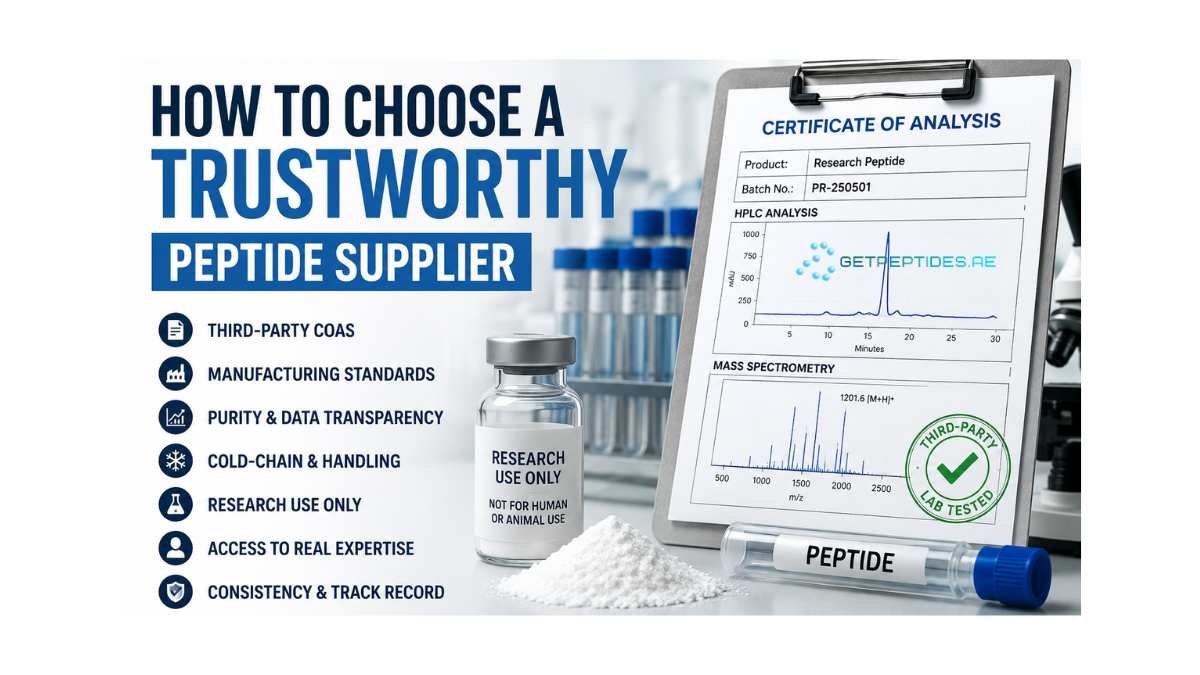
Peptide Supplier: The peptide research space has grown quickly, and with that growth has come a wide range of suppliers — some rigorous, some not. For laboratories, institutions, and qualified researchers sourcing peptides, the supplier you choose directly affects the reliability of your results. Here’s what actually matters when evaluating one.
1. Third-Party Certificates of Analysis (COAs)
A Certificate of Analysis should confirm identity and purity for the specific batch you’re purchasing — not a generic reference document reused across lots. Look for:
- Batch-specific COAs, not templated ones
- Testing performed by an independent, accredited lab (not solely in-house)
- HPLC (High-Performance Liquid Chromatography) results for purity
- Mass spectrometry data confirming peptide identity
If a supplier can’t produce a batch-matched COA on request, that’s a meaningful gap.
2. Manufacturing Standards
Ask where and how the product is manufactured. Reputable suppliers should be able to speak to:
- GMP (Good Manufacturing Practice) alignment at the production facility
- ISO-certified laboratory processes
- Sterility and endotoxin testing for injectable-format products
- Documented traceability from raw material to finished batch
Vague claims of “pharmaceutical grade” without supporting documentation are a red flag.
3. Purity Reporting, Not Just Purity Claims
Purity percentages are meaningless without the data behind them. A supplier should be willing to show — not just state — the HPLC chromatogram or spectrometry output supporting a purity claim, ideally per batch.
4. Cold-Chain and Handling
Peptides are sensitive to temperature and improper handling can degrade a compound before it ever reaches a bench. Ask about:
- Cold-chain shipping and insulated packaging
- Storage conditions prior to dispatch
- Guidance on handling and storage once received
5. Transparency About Intended Use
Legitimate research-peptide suppliers are explicit that their products are intended for laboratory research use only, not for human or animal consumption. This isn’t just a legal formality — it reflects whether a supplier takes regulatory and safety boundaries seriously. Be cautious of any supplier that blurs this line in its marketing.
6. Access to Real Expertise
Peptide research spans a wide range of applications, and a knowledgeable supplier should be able to answer substantive technical questions — sourcing, stability, documentation — rather than defaulting to sales language. Suppliers offering direct access to qualified scientific or medical staff for these conversations are generally a stronger bet than those that don’t.
7. Consistency and Track Record
Look for:
- Consistent batch-to-batch quality (ask for COAs across multiple past batches if possible)
- Clear, responsive communication channels
- A verifiable physical business address and operating history
The Short Version
A trustworthy peptide supplier will readily provide batch-specific COAs, be transparent about manufacturing and testing standards, handle cold-chain logistics properly, and be upfront that its products are for research use only. If a supplier is cagey about any of these points, treat that as a signal — not an oversight.