


When sourcing research peptides, one document carries more weight than almost any other: the Certificate of Analysis (COA). A properly prepared COA provides documented evidence about a specific production batch, including analytical testing methods, purity data, identification results, and traceability information. For research laboratories, universities, and scientific organizations, reviewing this document is an essential part of quality assessment.
Understanding how to verify peptide certificate of analysis helps researchers distinguish between well-documented laboratory research materials and products that lack sufficient quality documentation. While a COA does not replace independent laboratory testing or institutional quality assurance procedures, it provides valuable insight into the analytical testing performed on a specific batch.
Research Use Only: The information in this guide is intended solely for laboratory and scientific research purposes. Research peptides supplied by GetPeptides.ae are not intended for human or veterinary consumption.
In this guide, you’ll learn:
- What a peptide Certificate of Analysis is
- How to read every section of a COA
- The difference between purity and identity testing
- How HPLC and LC-MS results are interpreted
- Common warning signs of questionable documentation
- A practical checklist for verifying peptide quality documents before purchasing laboratory research materials
What Is a Peptide Certificate of Analysis?
A peptide Certificate of Analysis (COA) is a batch-specific laboratory document that summarizes analytical testing performed on a research peptide. It typically includes the product name, batch number, purity results, identification methods such as HPLC and LC-MS, manufacturing details, storage recommendations, and testing information to help researchers evaluate laboratory quality documentation.
A peptide Certificate of Analysis is an analytical report prepared after laboratory testing of a production batch. Rather than serving as a marketing document, it records measurable quality characteristics determined through established analytical methods.
Each COA should correspond to a specific manufacturing lot or batch. This allows laboratories to trace testing results directly to the material being supplied.
A complete COA improves transparency by documenting how the research material was evaluated before distribution.
Definition
A Certificate of Analysis is a formal laboratory record that summarizes analytical testing performed on a specific batch of research peptides. The document provides objective data instead of opinions or promotional claims.
Typical information includes:
- Product identification
- Batch information
- Analytical methods
- Purity results
- Identity confirmation
- Storage recommendations
- Testing dates
Because every production batch can differ slightly, each batch should ideally have its own COA rather than sharing a generic document across multiple lots.
Purpose
The primary purpose of a peptide COA is to provide transparency.
Researchers rely on these documents to understand:
- Which analytical methods were used
- Whether testing was batch specific
- How purity was measured
- Whether identity was confirmed
- Whether the documentation appears complete and internally consistent
A COA also supports laboratory recordkeeping by improving traceability throughout procurement and inventory processes.
Who Issues It?
A Certificate of Analysis may be prepared by:
- The manufacturer’s quality control laboratory
- An independent analytical laboratory
- A third-party testing facility
In many research settings, independent verification adds another layer of confidence because the analytical results are produced separately from manufacturing operations. Regardless of who issues the document, researchers should confirm that the laboratory information, testing methods, and batch identifiers are clearly stated.
Why Every Research Peptide Should Include a COA
Research peptides are commonly used in laboratory environments where documentation and traceability are essential. A batch-specific Certificate of Analysis provides researchers with information needed to evaluate the material before it enters a study or analytical workflow.
Quality Assurance
A COA demonstrates that analytical testing was performed and recorded. Although it is not a guarantee of future performance, it documents measurable characteristics observed during testing.
This allows researchers to review analytical data rather than relying solely on product descriptions.
Batch Consistency
Manufacturing occurs in batches. Even under controlled production conditions, each batch should be evaluated individually.
A batch-specific COA helps laboratories determine:
- whether testing corresponds to the supplied material,
- whether analytical values remain consistent across orders, and
- whether documentation supports quality assurance procedures.
Without batch-specific documentation, verifying consistency becomes more difficult.
Laboratory Traceability
Traceability is a core principle of laboratory quality systems.
A complete COA links analytical results to a specific manufacturing batch, making it easier to:
- document inventory,
- investigate quality concerns,
- compare batches over time, and
- maintain organized laboratory records.
Organizations following recognized quality systems often place significant emphasis on documentation and traceability throughout the procurement process.
Sections Found in a Peptide COA
What Should a COA Include?
A complete peptide Certificate of Analysis should include:
- Product name
- Batch number
- Lot number
- Manufacturing date
- Re-test or expiration date (if applicable)
- Storage conditions
- Purity results
- Identity confirmation
- Appearance description
- Analytical testing methods
- Laboratory information
- Authorized signature or approval
Every section contributes to understanding the analytical history of the research material.
Product Name
The product name should exactly match the item being supplied.
Researchers should verify:
- spelling,
- peptide designation,
- sequence identifier (where applicable), and
- concentration or presentation if listed.
Any inconsistency between the label and COA should be clarified before use.
Batch Number
The batch number is one of the most important identifiers on the document.
Every production batch should have its own unique identifier.
Researchers should confirm that:
- the batch number on the vial,
- the shipping label,
- the invoice, and
- the COA
all match.
A missing or inconsistent batch number may indicate poor documentation practices.
Lot Number
Although sometimes used interchangeably with batch number, lot number and batch number may represent different stages within manufacturing or packaging.
Researchers should simply ensure the numbering system remains consistent across all documentation.
Good traceability depends on accurate lot identification.
Manufacturing Date
Manufacturing dates help laboratories understand when production occurred.
This information supports:
- inventory management,
- document tracking,
- stability review, and
- recordkeeping.
Older manufacturing dates are not necessarily problematic, but they should align logically with testing dates and storage recommendations.
Expiration or Re-Test Date
Some manufacturers include a re-test date rather than a traditional expiration date.
A re-test date indicates when analytical verification should be repeated to confirm that documented quality characteristics remain current under appropriate storage conditions.
Researchers should understand the terminology used by the manufacturer and review any accompanying storage guidance.
Storage Conditions
Storage recommendations protect the integrity of laboratory research materials.
Typical storage instructions may specify:
- refrigerated storage,
- frozen storage,
- protection from moisture,
- protection from light, or
- controlled environmental conditions.
Researchers should verify that shipping and laboratory storage practices align with these recommendations.
Purity
Purity is among the most frequently reviewed values on a peptide COA.
It generally represents the percentage of the primary peptide component relative to detectable impurities when analyzed using specified analytical methods such as High-Performance Liquid Chromatography (HPLC).
It is important to remember that purity reflects one analytical characteristic. It should not be interpreted as the sole measure of overall product quality.
Identity
Identity testing confirms that the analytical characteristics correspond to the intended peptide.
Identity is commonly verified using techniques such as:
- LC-MS analysis
- Mass spectrometry
- Sequence confirmation methods
Identity answers a different question than purity.
Purity asks:
“How much of the sample consists of the intended component?”
Identity asks:
“Is this the expected peptide?”
Both measurements provide important but distinct information.
Appearance
Appearance is typically recorded through visual inspection.
Common descriptions include:
- White powder
- Off-white lyophilized powder
- White fluffy solid
Appearance alone cannot verify analytical quality, but it provides another documented observation within the quality assessment process.
Testing Methods
A transparent COA identifies the analytical methods used.
Common methods include:
| Testing Method | Primary Purpose |
|---|---|
| HPLC | Purity assessment |
| LC-MS | Identity confirmation |
| Mass Spectrometry | Molecular weight verification |
| Residual Solvent Analysis | Detect manufacturing solvent residues |
| Endotoxin Testing (when applicable) | Detect endotoxin contamination under relevant testing protocols |
Understanding the testing method helps researchers interpret analytical results appropriately.
Understanding HPLC Purity Results
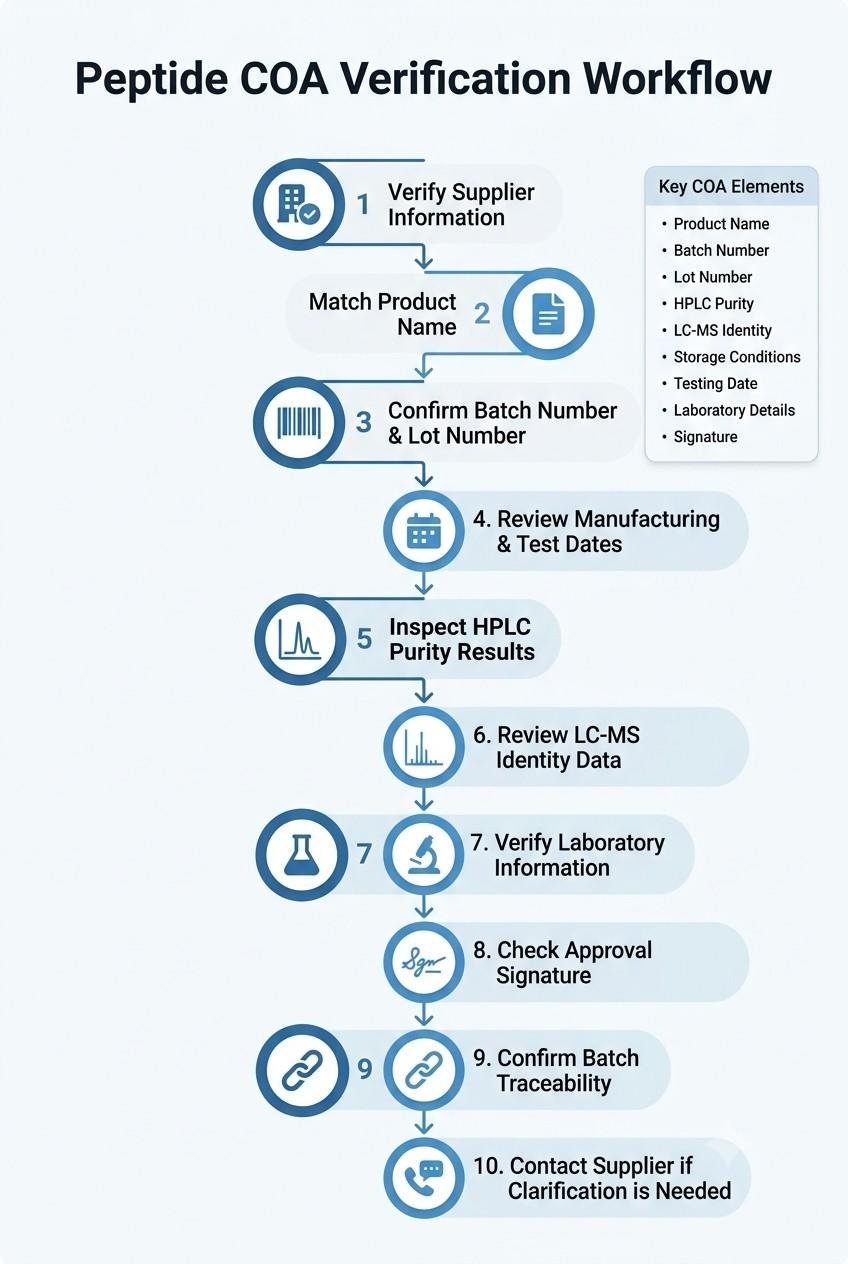
High-Performance Liquid Chromatography (HPLC) is one of the most widely used analytical techniques for evaluating peptide purity. It separates components within a sample based on their chemical interactions with the chromatographic system, allowing analysts to estimate the relative proportion of the primary peptide and detectable impurities.
Because HPLC is a standard analytical tool in pharmaceutical and research laboratories, it is frequently referenced in peptide Certificates of Analysis.
Reading Chromatograms
An HPLC chromatogram is a graphical representation of detector response over time.
Each visible peak generally represents a compound detected during the analysis.
When reviewing a chromatogram, researchers should look for:
- Clearly labeled axes
- Retention time values
- Peak integration data
- Appropriate report formatting
- Batch-specific information
- Laboratory identification
A chromatogram should appear complete and internally consistent rather than being a cropped image with little supporting information.
Peak Analysis
The largest peak usually represents the primary peptide component.
Additional smaller peaks may indicate detectable impurities or related compounds.
Researchers should examine:
- Total peak count
- Relative peak areas
- Integration values
- Peak symmetry
- Consistency with reported purity
While interpreting chromatograms requires analytical experience, obvious inconsistencies—such as reported purity values that do not appear to match the displayed peak areas—may warrant further clarification from the supplier.
Acceptable Purity Ranges (Descriptive, Not Prescriptive)
Research peptide COAs commonly report purity as a percentage determined by HPLC. The reported value reflects the analytical result for that specific batch under the stated test conditions.
Rather than focusing on a single percentage in isolation, researchers should evaluate purity alongside:
- Identity confirmation (for example, LC-MS results)
- Batch traceability
- Testing methodology
- Laboratory documentation
- Overall completeness of the COA
A well-documented COA presents these elements together, providing a more comprehensive view of the analytical testing performed.
Understanding LC-MS Results
Liquid Chromatography–Mass Spectrometry (LC-MS) combines chromatographic separation with mass analysis, making it one of the most widely accepted techniques for confirming peptide identity. While HPLC primarily evaluates purity, LC-MS helps verify that the detected compound corresponds to the expected molecular composition.
Molecular Weight
One of the key outputs of LC-MS is the measured molecular mass of the analyte. Researchers compare the observed mass spectrum with the theoretical molecular weight of the target peptide.
Small variations can occur because of ionization states and instrument settings, so results should always be interpreted within the context of the analytical method described in the COA.
Identity Confirmation
Identity confirmation is the process of demonstrating that the sample analyzed matches the expected peptide rather than another compound with similar characteristics.
A complete LC-MS section should typically include:
- Instrument or method reference
- Observed molecular mass
- Expected molecular mass (where reported)
- Sample identifier
- Batch reference
- Date of analysis
When LC-MS findings align with HPLC purity data and the batch information is consistent across the document, researchers gain greater confidence that the analytical report relates to the supplied research material.
Step-by-Step COA Verification Checklist
How to Verify Peptide Certificate of Analysis
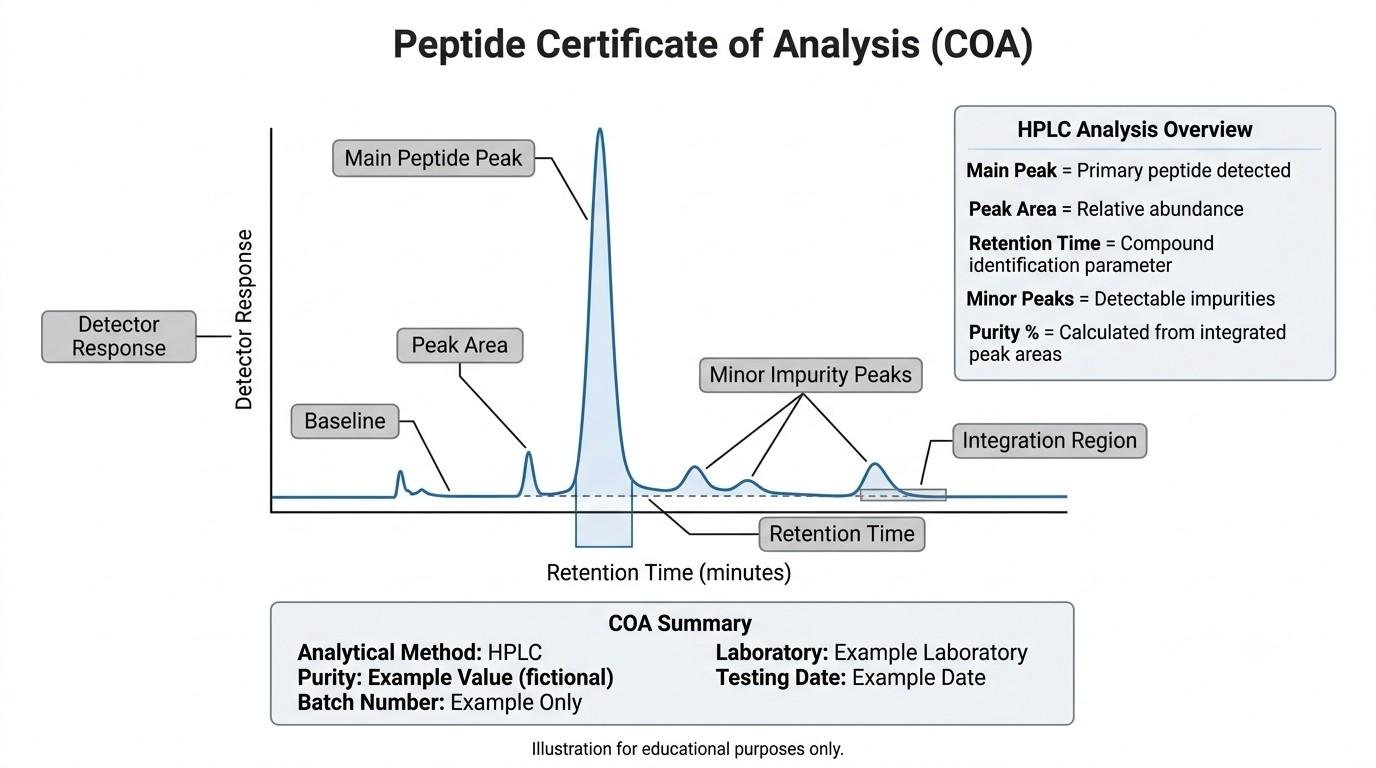
Follow these ten steps to evaluate a peptide Certificate of Analysis:
- Verify supplier information.
- Match the batch number.
- Confirm laboratory details.
- Review the HPLC chromatogram.
- Examine LC-MS identity data.
- Compare reported purity with analytical results.
- Check testing and issue dates.
- Verify signatures or quality approval.
- Confirm document traceability.
- Request clarification if information is missing.
Reviewing a COA should be a systematic process rather than a quick glance at the purity percentage. Looking at the document as a whole provides a better understanding of the analytical testing that supports the batch.
1. Verify Supplier Information
Start by checking that the document clearly identifies the supplier or manufacturer.
Look for:
- Company name
- Laboratory address (where applicable)
- Contact information
- Company logo or document header
- Quality department identification
Professional documentation should clearly identify its origin.
2. Check the Batch Number
The batch number is one of the most important traceability elements.
Verify that the batch number matches across:
- Product label
- Packaging
- Shipping documentation
- Certificate of Analysis
Even minor inconsistencies deserve clarification before the material enters laboratory inventory.
3. Confirm Laboratory Details
A reliable COA should identify who performed the testing.
Review whether the report includes:
- Laboratory name
- Testing location
- Analytical methods
- Report identification number
- Testing dates
The more transparent the documentation, the easier it is to evaluate.
4. Inspect the HPLC Chromatogram
Do not rely solely on the reported purity percentage.
Instead, examine whether the chromatogram appears complete.
Check for:
- Clearly integrated peaks
- Retention time values
- Peak area percentages
- Sample identification
- Batch reference
- Analysis date
A chromatogram that appears cropped, blurred, or missing key information should prompt additional questions.
5. Review LC-MS Data
Identity testing is equally important.
A complete LC-MS report should demonstrate that the measured molecular mass corresponds with the expected peptide.
Researchers should verify:
- Expected molecular weight
- Observed molecular weight
- Instrument method
- Sample identification
6. Match Purity Values
Review the numerical purity value alongside the chromatogram.
The analytical report should present consistent information throughout the document.
Large discrepancies between graphical data and reported values may indicate reporting errors or incomplete documentation.
7. Review Testing Dates
Analytical testing should logically align with manufacturing.
Confirm that:
- Manufacturing date
- Analysis date
- Report issue date
- Re-test date (if applicable)
follow a reasonable timeline.
8. Check Signatures and Approval
Many quality systems include approval by qualified personnel.
Look for:
- Analyst signature
- Quality Control approval
- Electronic approval
- Report authorization
While formats differ between organizations, approval records contribute to document authenticity.
9. Confirm Traceability
Every section of the COA should reference the same batch.
Researchers should verify consistency across:
- Product name
- Batch number
- Lot number
- Sample ID
- Analytical report number
Traceability is a cornerstone of laboratory documentation.
10. Contact the Supplier if Needed
If any information appears incomplete or inconsistent, request clarification.
Questions might include:
- Was testing performed on this specific batch?
- Can a higher-resolution chromatogram be provided?
- Which analytical laboratory performed testing?
- Are additional analytical reports available?
A reputable supplier should be willing to explain the documentation they provide.
Authentic COA vs. Suspicious COA
| Authentic COA | Suspicious COA |
|---|---|
| Batch-specific document | Generic document used for multiple batches |
| Batch number matches packaging | Missing or inconsistent batch number |
| Laboratory information provided | No laboratory identification |
| HPLC chromatogram included | No chromatogram |
| LC-MS identity data included | Identity testing absent |
| Complete testing dates | Missing analytical dates |
| Approval or signature present | No authorization |
| Clear analytical methods | Testing methods not described |
Common Signs of a Fake COA
Although most suppliers aim to provide accurate documentation, researchers should remain alert to inconsistencies that may indicate incomplete or unreliable records.
Missing Batch Number
A COA without a batch identifier cannot be linked to a specific production run.
Without traceability, the document has limited value for laboratory quality assurance.
No Laboratory Information
Analytical reports should identify who performed the testing.
Missing laboratory details reduce transparency and make independent evaluation more difficult.
Poor Image Quality
Blurry PDFs, cropped chromatograms, or unreadable figures may indicate that important information has been removed or obscured.
Whenever possible, request the original report rather than relying on low-quality images.
Edited Documents
Signs of editing may include:
- Different fonts
- Misaligned text
- Inconsistent spacing
- Pixelated numbers
- Cropped signatures
Formatting differences do not automatically indicate fraud, but they justify closer review.
Missing Test Methods
A COA should explain how analytical values were obtained.
If purity or identity is reported without describing the testing method, researchers have little context for interpreting the results.
Questions to Ask a Supplier
Before sourcing laboratory research materials, consider asking:
- Is the COA specific to this batch?
- Which laboratory performed the testing?
- Which analytical methods were used?
- Is HPLC data included?
- Is LC-MS identity testing available?
- Are chromatograms provided?
- How are batches tracked?
- Are documents archived for future reference?
- Can additional quality documentation be supplied if required?
- How is batch consistency monitored over time?
These questions help establish transparency while supporting institutional procurement procedures.
Best Practices for Researchers
Evaluating a COA is only one part of responsible laboratory quality management.
Researchers should also adopt documentation practices that support reproducibility and traceability.
Recommended practices include:
- Archive every batch-specific COA.
- Record batch numbers in laboratory notebooks.
- Store documentation alongside inventory records.
- Verify labels upon receipt.
- Follow manufacturer storage recommendations.
- Review analytical reports before beginning research.
- Maintain internal quality review procedures.
- Compare documentation across multiple batches when possible.
Consistent documentation helps laboratories maintain organized records and supports future review.
Frequently Asked Questions
What is a peptide Certificate of Analysis?
A peptide Certificate of Analysis is a batch-specific laboratory document summarizing analytical testing performed on a research peptide. It commonly includes purity data, identity confirmation, testing methods, batch identifiers, and storage recommendations.
How do you verify a COA?
Verify supplier information, confirm batch numbers, review laboratory details, inspect HPLC chromatograms, examine LC-MS results, compare reported values, check dates, verify approvals, confirm traceability, and request clarification when necessary.
Why is HPLC purity important?
HPLC provides an analytical estimate of the proportion of the primary peptide relative to detectable impurities. When interpreted alongside identity testing and batch documentation, it contributes to a broader assessment of laboratory quality.
What does peptide purity percentage mean?
The reported purity percentage represents the proportion of the primary peptide detected under the specified analytical conditions. It reflects the analytical result for that batch and should always be interpreted alongside the testing method used.
What is LC-MS in peptide testing?
Liquid Chromatography–Mass Spectrometry combines chromatographic separation with mass analysis to help confirm the identity of a peptide by comparing observed molecular mass with expected values.
Can a COA be fake?
Like any laboratory document, a COA can be incomplete, altered, or inaccurately presented. Researchers should review batch traceability, laboratory information, analytical methods, signatures, and supporting data before relying on the document.
Why is batch traceability important?
Batch traceability links analytical results to a specific manufacturing run. This improves recordkeeping, supports quality investigations, and helps laboratories maintain organized documentation.
Should every research peptide include a COA?
Providing a batch-specific COA is considered a best practice because it improves transparency and allows researchers to review analytical testing before incorporating laboratory research materials into their workflows.
Where can researchers learn more about analytical testing?
Researchers can consult authoritative scientific resources, including the National Institutes of Health (NIH), PubMed, the U.S. Food and Drug Administration (FDA), the European Medicines Agency (EMA), the World Health Organization (WHO), and International Council for Harmonisation (ICH) guidance documents for background information on analytical methods and quality systems.
Conclusion
Knowing how to verify peptide certificate of analysis is an important part of evaluating laboratory research materials. A thorough review extends beyond a single purity percentage and includes batch traceability, analytical methods, identity confirmation, laboratory documentation, and overall consistency.
By systematically reviewing HPLC chromatograms, LC-MS data, testing dates, batch numbers, and quality documentation, researchers can make more informed decisions when assessing research materials for laboratory use.
A transparent Certificate of Analysis demonstrates that analytical testing has been documented for a specific batch. Combined with sound laboratory practices and careful recordkeeping, it contributes to a more reliable research workflow.
Learn More About Research Quality Documentation
If you’re sourcing Research Peptides, choose suppliers that provide transparent, batch-specific Certificates of Analysis, clear analytical documentation, and well-organized quality records.
Explore the Research Peptide Collection, educational resources such as the Peptide Storage Guide, Peptide Purity Explained, and How Research Peptides Are Tested, or visit the About GetPeptides and Contact Our Team pages to learn more about the company’s commitment to laboratory research transparency.
Recommended External References
For additional information on analytical methods and laboratory quality practices, consult:
- National Institutes of Health (NIH)
- PubMed
- U.S. Food and Drug Administration (FDA)
- European Medicines Agency (EMA)
- World Health Organization (WHO)
- International Council for Harmonisation (ICH)
- Peer-reviewed analytical chemistry journals
- United States Pharmacopeia (USP) and European Pharmacopoeia (Ph. Eur.) analytical guidance