


Reliable Peptide Supplier UAE: Selecting a reliable peptide supplier is one of the most important decisions for laboratories, research organizations, and scientific professionals sourcing research peptides. While many suppliers advertise high-quality products, not all provide the same level of transparency, documentation, analytical testing, or quality assurance.
For laboratory research materials, quality extends far beyond the label on a vial. It includes batch consistency, analytical verification, proper packaging, storage practices, and the availability of supporting documentation such as a batch-specific Certificate of Analysis (COA). Choosing a supplier that openly shares this information helps researchers make informed purchasing decisions and supports reproducible laboratory work.
In the UAE, researchers also benefit from working with suppliers that understand local logistics, documentation expectations, and secure shipping practices for research-use-only (RUO) materials.
Important: The information in this guide is intended for educational purposes only. It discusses research peptides supplied exclusively for laboratory research use. It does not constitute medical advice and does not relate to products intended for human or veterinary use.
What Makes a Reliable Peptide Supplier UAE?
A reliable peptide supplier in the UAE provides transparent company information, batch-specific Certificates of Analysis (COAs), analytical testing such as HPLC and LC-MS, consistent quality control, appropriate packaging, documented storage practices, and responsive customer support. These factors help researchers evaluate the quality and traceability of laboratory research materials before purchasing.
Selecting a supplier should never be based on price alone. Lower prices may indicate reduced quality control, limited documentation, or inconsistent manufacturing standards. Instead, researchers should evaluate suppliers using objective quality indicators that demonstrate transparency and accountability.
The sections below explain the key characteristics of a trustworthy supplier.
Transparency
Transparency is often the easiest indicator of supplier credibility.
A reputable supplier should clearly explain:
- who they are
- where they operate
- how customers can contact them
- what documentation they provide
- how their quality control process works
Legitimate suppliers typically maintain a professional website with clear policies covering shipping, returns, privacy, and terms of service. Contact details should be easy to find, and customer inquiries should receive timely responses.
Transparency also extends to product information. Each research peptide listing should include accurate descriptions, storage recommendations, and references to supporting analytical documentation where appropriate.
When essential information is missing, researchers should proceed carefully and request clarification before placing an order.
Quality Assurance
Quality assurance is much more than simply stating that a product is “high purity.”
Reliable suppliers establish documented quality systems that include:
- batch testing
- analytical verification
- standardized handling procedures
- controlled packaging
- traceability throughout production and distribution
These practices help ensure consistency between production batches and reduce variability in laboratory research.
Many reputable suppliers also explain the analytical techniques used to evaluate their products, allowing researchers to understand how purity and identity have been assessed.
Research Documentation
Documentation plays a central role in scientific transparency.
Reliable suppliers typically provide information such as:
- batch numbers
- manufacturing dates (when appropriate)
- storage recommendations
- analytical testing results
- Certificate of Analysis
Comprehensive documentation allows researchers to verify important product information rather than relying solely on marketing claims.
Signs of a Trustworthy Supplier
A trustworthy research peptide supplier should provide:
- Batch-specific Certificates of Analysis
- Analytical testing using recognized laboratory methods
- Clear company and contact information
- Transparent product documentation
- Appropriate storage and shipping guidance
- Consistent batch identification
- Responsive customer support
- Secure ordering and payment processes
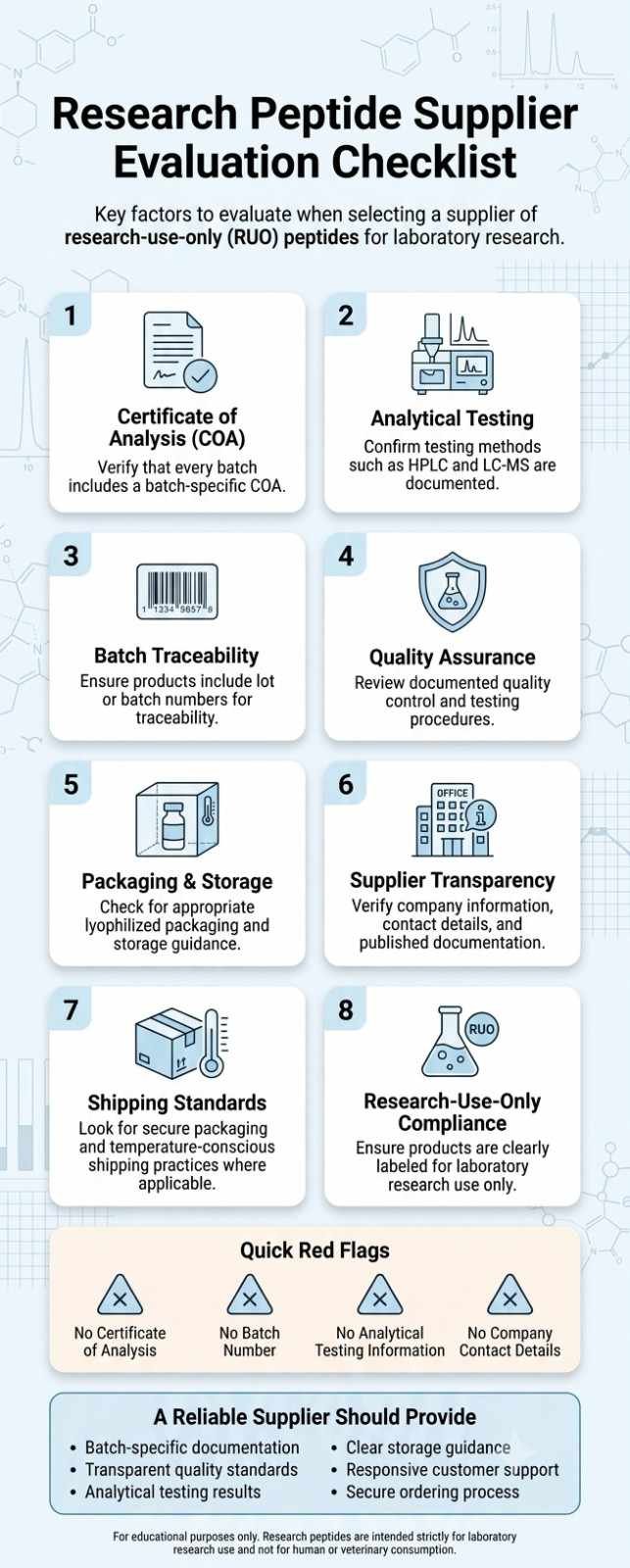
Check for a Certificate of Analysis (COA)
One of the most valuable documents a supplier can provide is a Certificate of Analysis (COA).
A COA summarizes analytical testing performed on a specific batch of laboratory research material. Rather than relying on general product descriptions, researchers can review documented testing results for the exact batch they are purchasing.
Although COA formats may vary between laboratories, they generally provide information that supports product identification, quality verification, and traceability.
What Should a COA Include?
A well-prepared Certificate of Analysis often contains:
| COA Section | Why It Matters |
|---|---|
| Product name | Confirms product identity |
| Batch or lot number | Enables traceability |
| Date of analysis | Shows when testing was performed |
| Purity result | Indicates analytical purity measurement |
| Testing methods | Explains how quality was evaluated |
| Laboratory information | Identifies the testing organization |
| Analyst approval | Demonstrates review before release |
Researchers should ensure the batch number shown on the COA matches the product they receive whenever applicable.
If a supplier cannot provide a COA or refuses to discuss analytical testing, this should be considered a warning sign.
How to Verify Authenticity
Receiving a COA is only the first step.
Researchers should also review whether the document appears complete and internally consistent.
Consider the following questions:
- Does the batch number match the product?
- Are analytical methods identified?
- Are dates included?
- Is the document professionally formatted?
- Does the information appear specific rather than generic?
Some suppliers publish identical COAs across multiple batches. Genuine analytical documentation is generally batch-specific because each production lot is tested independently.
Practical Tip
Rather than asking whether a supplier has a COA, ask whether they can provide a batch-specific Certificate of Analysis for the exact research material being purchased.
This encourages greater transparency and demonstrates whether documentation is maintained consistently.
Understand Peptide Purity Testing
Analytical testing provides objective evidence that laboratory research materials meet established quality specifications.
While several analytical methods exist, two techniques are widely discussed in peptide characterization:
- High-Performance Liquid Chromatography (HPLC)
- Liquid Chromatography–Mass Spectrometry (LC-MS)
Each technique provides different information, and together they offer a more complete understanding of sample quality.
HPLC
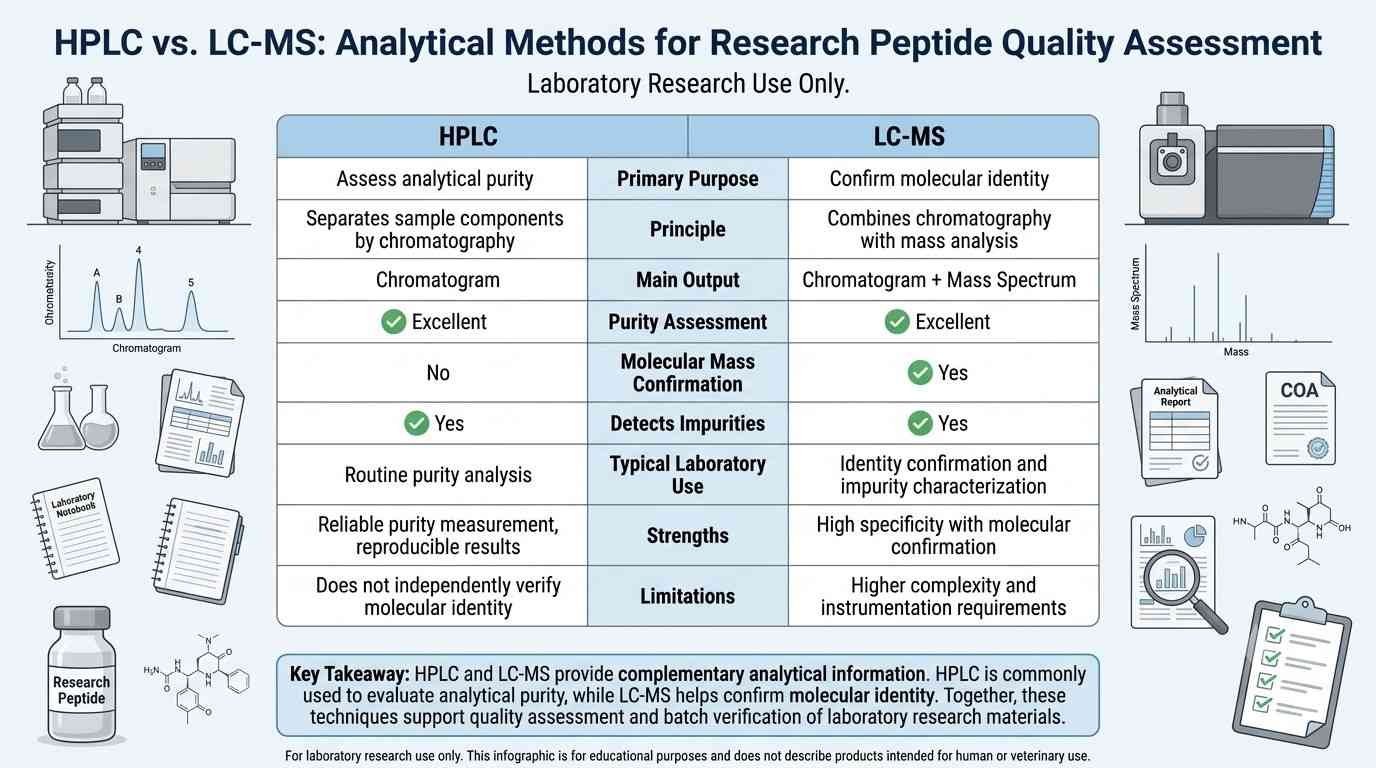
High-Performance Liquid Chromatography (HPLC) is one of the most widely used analytical techniques for assessing peptide purity.
The method separates compounds within a sample based on their chemical properties.
During analysis, researchers evaluate chromatograms that display peaks corresponding to different components present in the sample.
In general:
- A dominant primary peak may indicate the desired peptide.
- Smaller peaks may represent impurities or by-products.
- The relative peak area contributes to the reported purity percentage.
HPLC is widely recognized because it provides reproducible measurements under controlled laboratory conditions.
However, HPLC alone does not fully confirm molecular identity.
LC-MS
Liquid Chromatography–Mass Spectrometry (LC-MS) combines chromatographic separation with mass analysis.
Where HPLC primarily evaluates purity, LC-MS helps verify molecular mass.
This provides an additional level of confidence that the analyzed material corresponds to the expected peptide rather than another compound with similar chromatographic behavior.
Because these techniques measure different characteristics, many laboratories use both methods during analytical evaluation.
Batch Testing
Reliable suppliers understand that quality can vary between manufacturing batches.
For this reason, batch testing is an important component of quality assurance.
Rather than assuming every production run performs identically, individual batches are evaluated to confirm that analytical specifications have been met before release.
Batch testing also supports:
- product consistency
- traceability
- documentation accuracy
- quality monitoring over time
When comparing suppliers, researchers should look for evidence that testing is performed on individual batches instead of relying on historical data.
HPLC vs. LC-MS Comparison
| Feature | HPLC | LC-MS |
|---|---|---|
| Primary purpose | Assess purity | Confirm molecular identity |
| Analytical output | Chromatogram | Mass spectrum plus chromatogram |
| Detects impurities | Yes | Yes |
| Confirms molecular mass | No | Yes |
| Commonly used for peptide characterization | Yes | Yes |
Evaluate Packaging and Storage
The quality of research peptides depends not only on manufacturing and analytical testing but also on how they are packaged, stored, and transported. Even well-characterized laboratory research materials can be compromised if improper handling occurs after production.
A reliable peptide supplier UAE should clearly explain packaging methods, recommended storage conditions, and shipping procedures to help preserve product integrity during transit.
Lyophilized Packaging
Many research peptides are supplied in lyophilized (freeze-dried) form because this improves stability during storage and transportation compared to liquid formulations.
A professionally packaged product should typically include:
- Properly sealed laboratory vials
- Clearly printed product labels
- Batch or lot number
- Recommended storage conditions
- Research-use-only (RUO) labeling where applicable
Labels should be durable and easy to read. Missing or handwritten labels can make traceability more difficult and should prompt additional questions before purchasing.
Temperature Protection
Environmental conditions can affect many laboratory research materials. Although storage recommendations vary depending on the specific peptide, suppliers should provide clear guidance for:
- Recommended storage temperature
- Handling after delivery
- Protection from moisture
- Light exposure, when relevant
- Long-term storage considerations
A trustworthy supplier does not assume researchers already know these requirements. Instead, they provide written storage recommendations with each product or on the product page.
If shipping conditions require temperature control, suppliers should explain the measures taken to protect products during transit.
Shipping Methods
Shipping is more than simply delivering a package.
Professional suppliers should have documented procedures for:
- Secure packaging
- Protective insulation (where appropriate)
- Tracking information
- Timely dispatch
- Clear delivery communication
Researchers should also verify:
- Expected delivery times
- Shipping policies
- Procedures for damaged shipments
- Customer support availability
Reliable logistics reduce uncertainty and help maintain confidence in product handling throughout the supply chain.

Review Supplier Transparency
Transparency extends beyond product specifications. It reflects how openly a company communicates with customers before and after a purchase.
A supplier willing to answer technical questions and provide supporting documentation demonstrates a stronger commitment to quality than one relying solely on promotional claims.
Company Information
A professional supplier should clearly display:
- Company name
- Business location
- Contact information
- Website policies
- Terms and conditions
- Privacy policy
Researchers should be cautious if basic business information is difficult to locate or appears incomplete.
For UAE-based suppliers, locally relevant information and clear business communication can simplify purchasing and customer support.
Contact Details
Reliable suppliers make it easy for customers to get assistance.
Look for:
- Email support
- Contact forms
- Telephone numbers
- Business hours
- Responsive customer service
Before placing a larger order, consider asking a technical question. The quality and speed of the response often provide insight into the supplier’s professionalism.
Documentation Availability
Reliable suppliers understand that documentation is part of the purchasing decision.
Useful documents may include:
- Certificate of Analysis (COA)
- Storage recommendations
- Product specifications
- Batch information
- Shipping policies
- Quality assurance information
Suppliers that openly provide documentation help researchers evaluate products more confidently before ordering.
Questions to Ask Before Ordering
Before selecting a research peptide supplier, prepare a checklist of questions.
These questions can help distinguish suppliers that prioritize quality from those that provide limited information.
Supplier Evaluation Questions
- Is a batch-specific Certificate of Analysis available?
- Which analytical methods were used (for example, HPLC or LC-MS)?
- Are batch numbers included on product labels?
- What storage conditions are recommended?
- How are products packaged for shipment?
- Is quality documentation available before purchase?
- How can technical questions be answered?
- What happens if a shipment arrives damaged?
- Are shipping timelines clearly explained?
- Is customer support easy to contact?
The goal is not simply to compare prices but to compare transparency, documentation, and quality practices.
Common Warning Signs
Not every supplier follows the same quality standards.
Recognizing common warning signs can help researchers avoid unnecessary risk.
No Certificate of Analysis
If a supplier cannot provide a Certificate of Analysis, researchers have little objective evidence regarding the quality of a specific batch.
While not every laboratory presents documentation in the same format, complete absence of analytical documentation should encourage additional scrutiny.
No Analytical Testing Information
Some suppliers advertise “high purity” without explaining how that conclusion was reached.
Researchers should look for references to recognized analytical techniques rather than unsupported quality claims.
Testing methods such as HPLC and LC-MS are commonly used to characterize research peptides and provide greater transparency regarding analytical evaluation.
No Batch Numbers
Batch numbers are essential for traceability.
Without them, it becomes difficult to:
- Match products to analytical documentation
- Investigate quality concerns
- Verify manufacturing records
Batch identification is a basic component of quality management.
No Contact Information
Professional suppliers should be easy to contact.
If a website lacks:
- Business details
- Customer support
- Email address
- Contact page
researchers may find it difficult to resolve questions after placing an order.
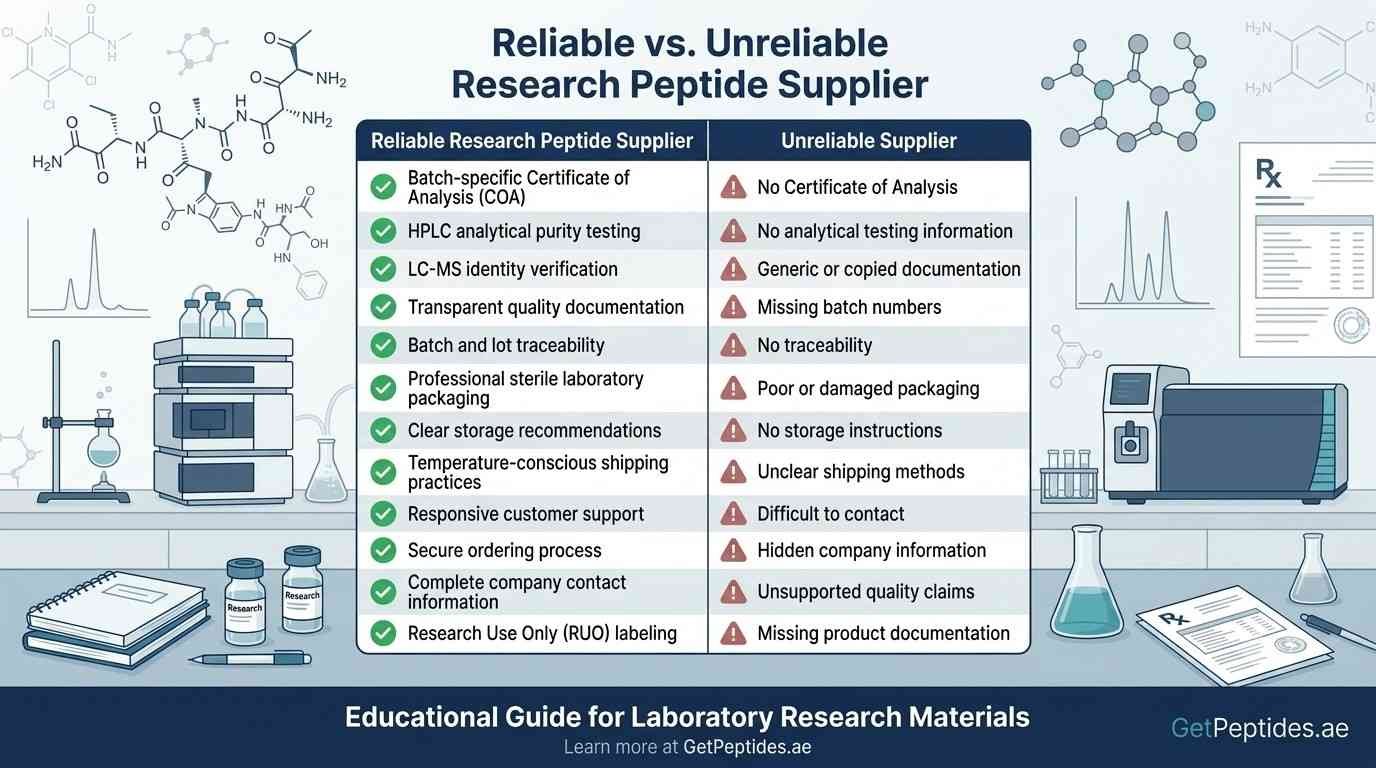
Reliable Supplier vs. Poor Supplier
| Reliable Supplier | Poor Supplier |
|---|---|
| Provides batch-specific COAs | No COA available |
| Explains analytical testing | Makes unsupported quality claims |
| Lists batch numbers | No traceability |
| Clear company information | Limited business details |
| Responsive customer support | Difficult to contact |
| Transparent shipping policies | Shipping information unclear |
| Storage guidance available | No storage recommendations |
Supplier Evaluation Checklist
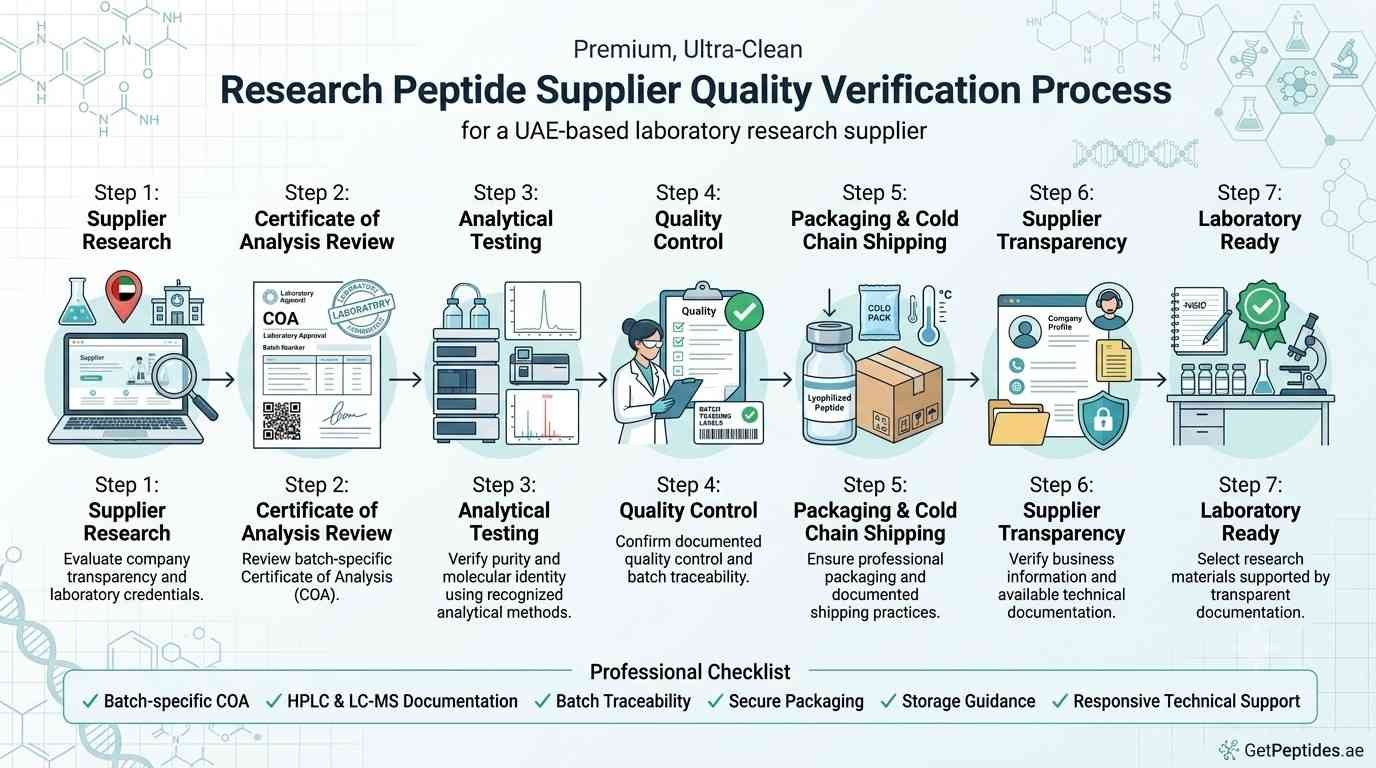
7 Steps to Evaluate a Reliable Peptide Supplier UAE
This checklist summarizes the key points discussed throughout this guide.
- Review the supplier’s company information and ensure contact details and business policies are clearly available.
- Request a batch-specific Certificate of Analysis (COA) to verify analytical documentation.
- Confirm analytical testing methods, such as HPLC and LC-MS, are used where appropriate.
- Check packaging and storage guidance to ensure products are handled according to documented recommendations.
- Verify batch numbers and traceability on product labels and supporting documentation.
- Evaluate customer support by asking technical or documentation-related questions before ordering.
- Compare suppliers based on transparency rather than price alone.
Saving this checklist can make future supplier comparisons faster and more consistent.
Frequently Asked Questions
How do I know if a peptide supplier is reliable?
Look for objective indicators such as batch-specific Certificates of Analysis, recognized analytical testing methods, transparent company information, documented quality practices, and responsive customer support. Reliable suppliers provide evidence rather than relying solely on marketing claims.
What is a Certificate of Analysis (COA)?
A Certificate of Analysis is a document summarizing analytical testing performed on a specific production batch. It typically includes product identification, batch number, testing methods, analytical results, and quality information.
Why is peptide purity important?
Purity measurements help researchers understand the composition of laboratory research materials. Analytical testing contributes to quality assessment and supports consistency between batches.
What laboratory methods are commonly used to evaluate research peptides?
High-Performance Liquid Chromatography (HPLC) is commonly used to assess purity, while Liquid Chromatography–Mass Spectrometry (LC-MS) helps confirm molecular identity. These methods provide complementary analytical information.
What is Research Use Only (RUO)?
Research Use Only (RUO) indicates that a product is intended exclusively for laboratory research purposes. RUO materials are not intended for human or veterinary use and should only be handled in accordance with applicable laboratory practices and regulations.
Why are batch numbers important?
Batch numbers improve traceability by linking products to manufacturing and analytical records. They also help suppliers investigate quality questions if they arise.
Should suppliers provide storage recommendations?
Yes. Clear storage guidance helps laboratories maintain product quality after delivery. Recommendations should be specific to the product and supplied in writing whenever possible.
Are lower prices always better?
Not necessarily. Price should be considered alongside documentation, analytical testing, transparency, packaging standards, and customer support. A lower-cost product with limited quality information may not provide the same level of confidence for laboratory research.
Conclusion
Choosing a reliable peptide supplier UAE involves much more than comparing product prices or browsing online catalogs. The most dependable suppliers distinguish themselves through transparency, quality assurance, analytical documentation, and consistent communication.
When evaluating laboratory research materials, prioritize suppliers that provide batch-specific Certificates of Analysis, explain their testing methods, maintain traceability through batch numbers, and publish clear guidance for packaging, storage, and shipping. These practices help researchers make informed purchasing decisions based on objective information rather than marketing claims.
As the research peptide market continues to grow, investing time in supplier evaluation can contribute to greater confidence in sourcing decisions and support consistent laboratory standards.