

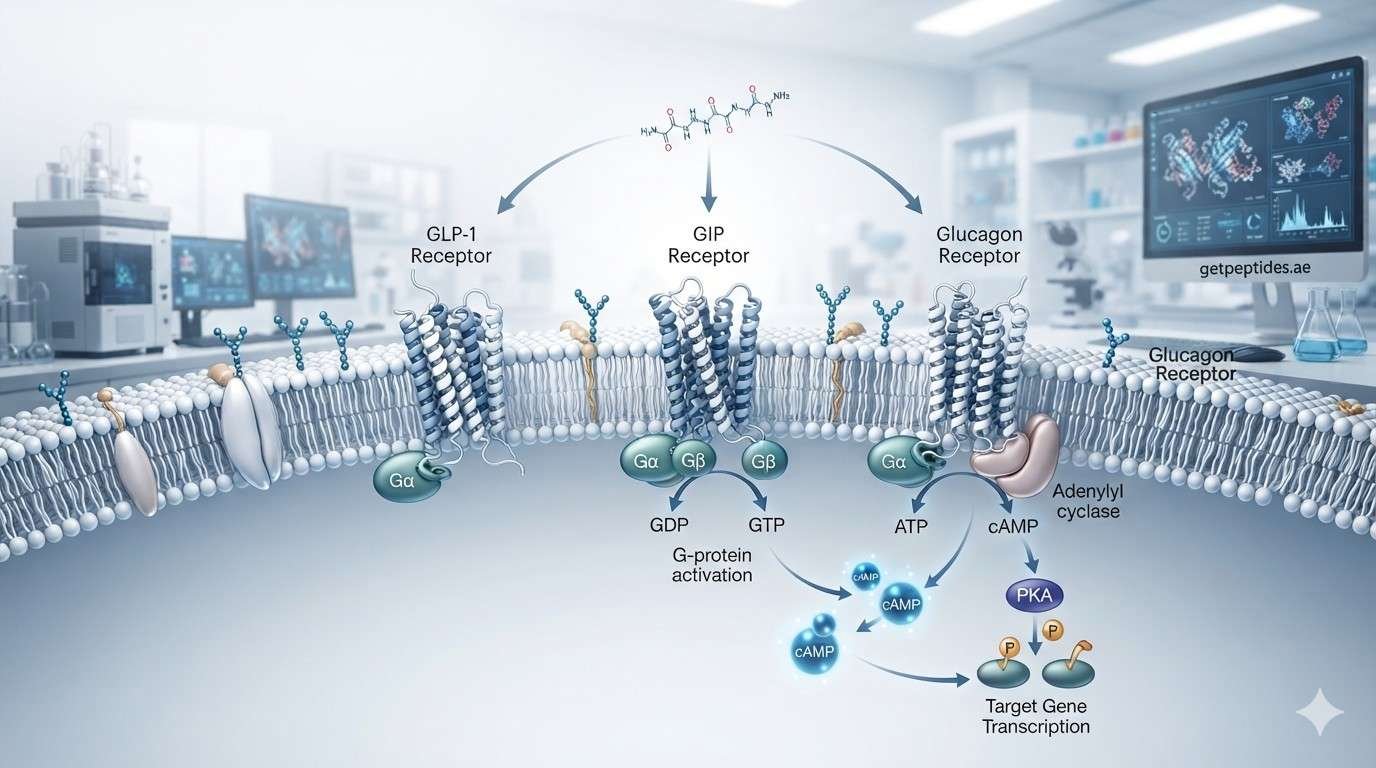
The phrase triple receptor agonist meaning points to one of the more elegant ideas in modern molecular pharmacology: a single molecule designed to engage three different cell-surface receptors at once. To understand what that actually describes — and why it interests basic researchers — it helps to start not with the molecule, but with the receptors themselves.
Cells do not act in isolation. They constantly read chemical signals from their environment and translate those signals into internal responses. The proteins that perform this translation are called receptors. Receptor pharmacology is the study of how signalling molecules bind to these proteins and how that binding is converted into a biological output.
Why do so many different receptors exist? Because biological communication needs precision. A hormone released into the bloodstream may reach nearly every tissue, yet only cells carrying the matching receptor will respond. Multiple receptor types allow the same broad signalling system — such as the regulation of energy homeostasis — to be tuned differently in different tissues.
Scientists study receptor signalling because it sits at the intersection of chemistry and biology. Understanding how a ligand engages a receptor, and what happens next inside the cell, is foundational to structural biology, biochemistry, and experimental pharmacology. This article explains those fundamentals, then applies them to three related receptors of the incretin system: the GLP-1, GIP, and glucagon receptors.
This article is educational. It describes molecular and cellular biology. It does not provide medical, therapeutic, or dosing information, and it makes no claims about health outcomes.
View Retatrutide 30 mg Research Material
What Is a Triple Receptor Agonist?
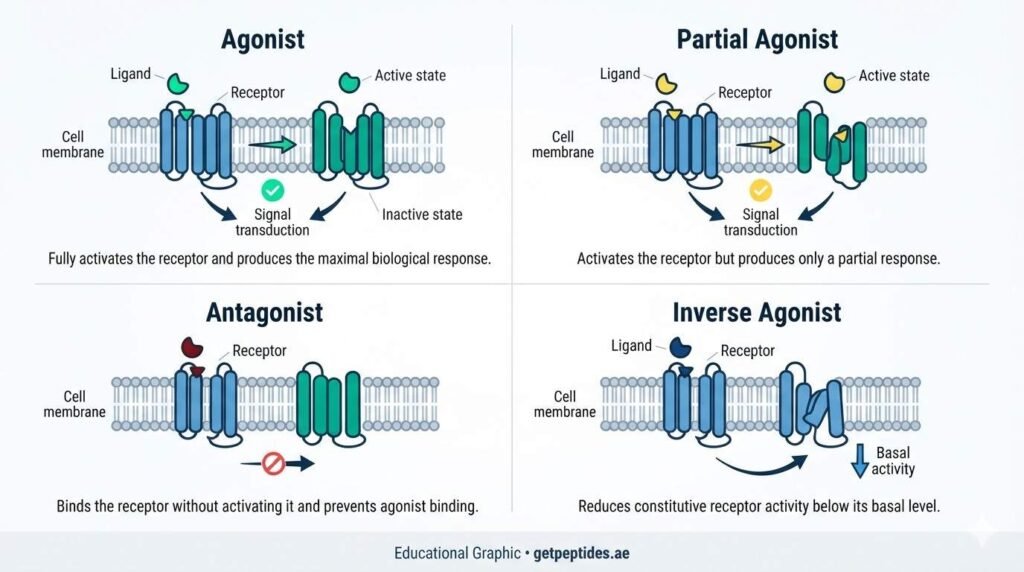
A ligand is any molecule that binds to a receptor. The word comes from the Latin ligare, “to bind.” Whether a ligand switches a receptor “on,” “off,” or somewhere in between defines its pharmacological class.
- Agonist — a ligand that binds a receptor and activates it, producing a signalling response. A useful analogy is a key that both fits a lock and turns it.
- Partial agonist — binds and activates, but produces a weaker maximal response than a full agonist, even when every receptor is occupied. The key turns the lock only part-way.
- Antagonist — binds the receptor but does not activate it. By occupying the site, it can block agonists from binding. This key fits the lock but will not turn, and while it sits there no other key can enter.
- Inverse agonist — binds a receptor that has some baseline (“constitutive”) activity and reduces that activity below its resting level. Rather than doing nothing, it actively dials the signal down.
A triple-receptor agonist, then, is simply a single molecule that acts as an agonist at three distinct receptors. The concept says nothing about outcomes; it is a description of molecular behaviour — one ligand, three activation events.
GPCR Biology Explained
The GLP-1, GIP, and glucagon receptors all belong to the largest family of cell-surface receptors in the human genome: the G-protein coupled receptors (GPCRs). Understanding how a GPCR works makes the rest of this topic far clearer.
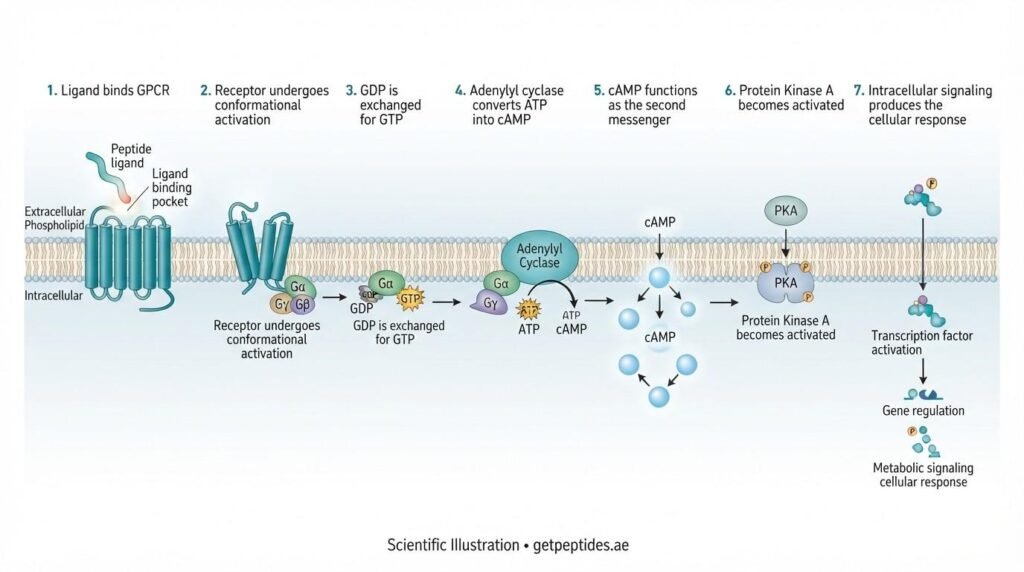
A GPCR is a protein that threads through the cell membrane seven times, giving it an extracellular portion that can recognise a ligand and an intracellular portion that can relay a message. This architecture is why GPCRs are sometimes called seven-transmembrane receptors.
The signalling logic follows a consistent sequence:
- Receptor activation. A ligand binds the receptor’s extracellular region, and the receptor changes shape (a conformational change).
- G-protein activation. The new shape allows the receptor to couple with an intracellular partner called a G protein, prompting it to exchange GDP for GTP and split into active subunits.
- Second-messenger production. For the receptors discussed here, the activated G protein stimulates an enzyme (adenylyl cyclase) that produces cyclic AMP (cAMP) — a classic second messenger. This is the heart of the cAMP pathway.
- Intracellular cascade. Rising cAMP activates downstream effectors such as protein kinase A, propagating the signal through the cell. This is the downstream signalling stage, where one external event is amplified into many internal ones.
Cells also switch signals off. After activation, receptors can undergo desensitisation — a temporary loss of responsiveness — and internalisation, in which the receptor is pulled inside the cell. These processes prevent runaway signalling and reset the system, and they are central to how signal transduction is regulated over time.
A simplified way to picture it: the ligand is a knock at the door, the GPCR is the door, the G protein is the messenger who runs inside, and cAMP is the note the messenger delivers to the rest of the household. Desensitisation is the household briefly deciding to stop answering repeated knocks.
Understanding the Incretin System
The term incretin describes gut-derived hormones released after nutrient intake that influence pancreatic signalling. Two of the receptors below respond to classic incretin hormones (GLP-1 and GIP); the third, the glucagon receptor, is related but distinct. All three are GPCRs that raise cAMP, which is why they can be discussed as a family — yet each has its own expression pattern and biology.
GLP-1 Receptor
The GLP-1 receptor binds glucagon-like peptide-1. It is expressed in pancreatic beta cells as well as in the nervous system, gastrointestinal tract, and other tissues. In beta cells, GLP-1 receptor activation raises cAMP in a glucose-dependent manner, a property that has made it a heavily studied model of GPCR signalling. Its broad tissue distribution is one reason researchers map where the receptor is expressed before interpreting any downstream result.
GIP Receptor
The GIP receptor binds glucose-dependent insulinotropic polypeptide. Like the GLP-1 receptor, it is a cAMP-coupled GPCR present on pancreatic islet cells, but it is also notably expressed in adipose tissue and bone. Although GLP-1 and GIP are often grouped together as incretins, their receptors are encoded by different genes, recognise different ligands, and show different tissue distributions — a clear illustration that related does not mean identical.
Glucagon Receptor
The glucagon receptor binds glucagon and is expressed prominently in the liver. Physiologically, glucagon signalling is often considered in the context of energy mobilisation, complementing rather than duplicating incretin signalling. Because it engages a different tissue profile, adding glucagon-receptor activity to a molecule changes which cells “hear” the signal.
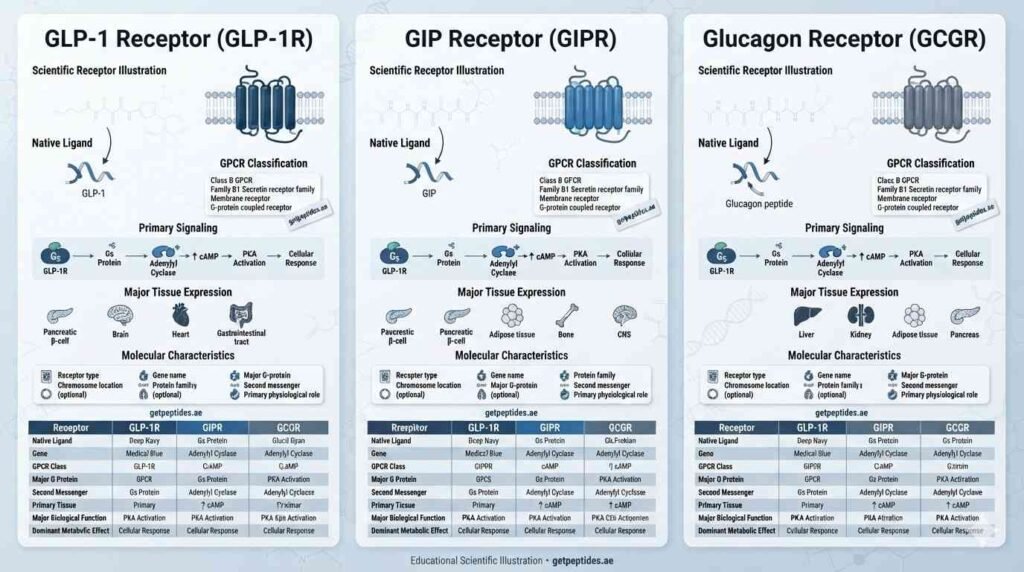
| Feature | GLP-1 receptor | GIP receptor | Glucagon receptor |
|---|---|---|---|
| Native ligand | GLP-1 | GIP | Glucagon |
| Receptor family | Class B GPCR | Class B GPCR | Class B GPCR |
| Main second messenger | cAMP | cAMP | cAMP |
| Notable expression sites | Pancreas, CNS, gut | Pancreas, adipose, bone | Liver, kidney |
| Relationship | Incretin | Incretin | Incretin-related |
What Is Triple Receptor Agonism?
With the receptors defined, triple-receptor agonism can be stated precisely: it is the simultaneous engagement of the GLP-1, GIP, and glucagon receptors by one molecule that acts as an agonist at each. Several concepts describe how such engagement is characterised in the laboratory.
- Binding affinity — how tightly a ligand associates with a receptor. Higher affinity means the ligand and receptor stay bound at lower concentrations.
- Selectivity — the degree to which a ligand prefers one receptor over others. A triple agonist is deliberately less selective by design, but its relative activity at each receptor still varies.
- Receptor occupancy — the fraction of available receptors bound at a given moment.
- Functional activity — what actually happens after binding (for these receptors, how much cAMP is generated), which is not always predictable from binding alone.
- Biased signalling — the observation that different ligands at the same receptor can preferentially activate some downstream pathways (for example, G-protein signalling versus beta-arrestin recruitment) over others.
- Cross-talk — interactions between the signalling outputs of different receptors within the same cell.
The important scientific point is that these are molecular descriptors. They characterise interactions between chemistry and cell biology, not outcomes in any organism.
Why Researchers Study Multi-Receptor Pharmacology
Investigating molecules that engage several receptors is a way to probe fundamental questions in molecular biology and experimental pharmacology:
- Structure–function relationships. Comparing how a single sequence interacts with three related receptors helps map which molecular features drive binding and activation.
- Drug discovery science. Multi-target ligands are a major theme in medicinal-chemistry research because they test whether one molecule can be tuned across several targets.
- Receptor biology. Studying combined activation clarifies how related GPCRs signal, desensitise, and potentially interact.
- Preclinical models. Cell lines and laboratory assays allow researchers to quantify activity at each receptor under controlled conditions.
These are questions about how biology works at the molecular level. This article makes no claims about efficacy, therapeutic value, or health effects — those lie outside the scope of basic receptor pharmacology.
How Scientists Measure Receptor Activity
Receptor pharmacology is quantitative. A handful of standard measurements recur throughout the literature.
- Binding assays determine how well a ligand attaches to a receptor.
- Radioligand binding uses a radioactively labelled ligand to measure how a test molecule competes for the binding site.
- Fluorescence assays replace radioactivity with fluorescent labels to track binding or signalling in real time.
- Cell-based assays measure a functional output — commonly cAMP accumulation — after receptor activation.
- Beta-arrestin assays detect recruitment of beta-arrestin, one readout used to study biased signalling.
Several numerical parameters summarise these experiments:
- Kd (dissociation constant) — the concentration at which half the receptors are bound; a direct measure of binding affinity.
- Ki (inhibition constant) — the affinity of a competing ligand, derived from competition binding experiments.
- EC50 — the concentration of an agonist that produces half of its maximal functional response.
- IC50 — the concentration of an inhibitor that reduces a response by half.
A lower Kd or EC50 indicates that less ligand is needed, which is why these values are central to comparing molecules across the GLP-1, GIP, and glucagon receptors.
Definition callout — receptor binding affinity: a quantitative measure of how strongly a ligand and receptor associate, typically expressed as Kd or Ki. It reflects binding strength, not biological consequence.
Common Misconceptions
“All receptor agonists are identical.” They are not. Agonists differ in affinity, selectivity, maximal response, and signalling bias. Two agonists at the same receptor can produce measurably different intracellular outputs.
“Binding equals biological response.” Binding is necessary but not sufficient. A molecule can occupy a receptor without fully activating it — that is precisely what antagonists and partial agonists demonstrate. Functional assays exist because occupancy and activity must be measured separately.
“Higher affinity always means a stronger effect.” Affinity describes how tightly a ligand binds, not how strongly it activates. A high-affinity partial agonist can bind tightly yet produce a modest functional response, while a lower-affinity full agonist may produce a larger one.
Frequently Asked Questions
What is a triple agonist peptide?
It is a single peptide molecule that behaves as an agonist — an activating ligand — at three separate receptors. In the metabolic-research context discussed here, those receptors are the GLP-1, GIP, and glucagon receptors.
How do incretin receptors work?
The GLP-1 and GIP receptors are G-protein coupled receptors. When their ligand binds, they activate a G protein, stimulate production of the second messenger cAMP, and trigger downstream signalling inside the cell.
What is the difference between GLP-1 and GIP?
They are different hormones that bind different receptors encoded by different genes. Both are incretins and both couple to cAMP signalling, but their receptors show distinct tissue-expression patterns.
Is a GPCR the same as a receptor agonist?
No. A GPCR is a type of receptor protein. An agonist is a ligand that activates a receptor. The GLP-1, GIP, and glucagon receptors are GPCRs; a molecule that activates them is an agonist.
Why do scientists study simultaneous receptor activation?
To understand structure–function relationships, receptor biology, and the principles of multi-target molecular design — all questions in basic and experimental pharmacology.
What does binding affinity actually measure?
It measures how tightly a ligand associates with a receptor, commonly reported as Kd or Ki. It does not measure the size of the biological response.
What is biased signalling?
It is the phenomenon in which different ligands at the same receptor preferentially activate different downstream pathways, such as G-protein versus beta-arrestin signalling.
Does this article describe a treatment?
No. It explains receptor pharmacology and cell signalling as educational, laboratory-science concepts. It contains no medical, therapeutic, or dosing information.
View Retatrutide 30 mg Research Material
Conclusion
The triple receptor agonist meaning becomes clear once the underlying pharmacology is unpacked: it is a single molecule that acts as an agonist at three related G-protein coupled receptors — the GLP-1, GIP, and glucagon receptors — each of which signals through the cAMP pathway but occupies its own place in the biology of energy homeostasis. From the definition of a ligand, through GPCR signal transduction, to the quantitative language of Kd, EC50, and biased signalling, receptor pharmacology offers a rigorous framework for describing how chemistry becomes cellular behaviour. What it does not offer — and what this article deliberately avoids — is any claim about health, treatment, or outcomes. Those remain separate questions, distinct from the molecular science described here.