

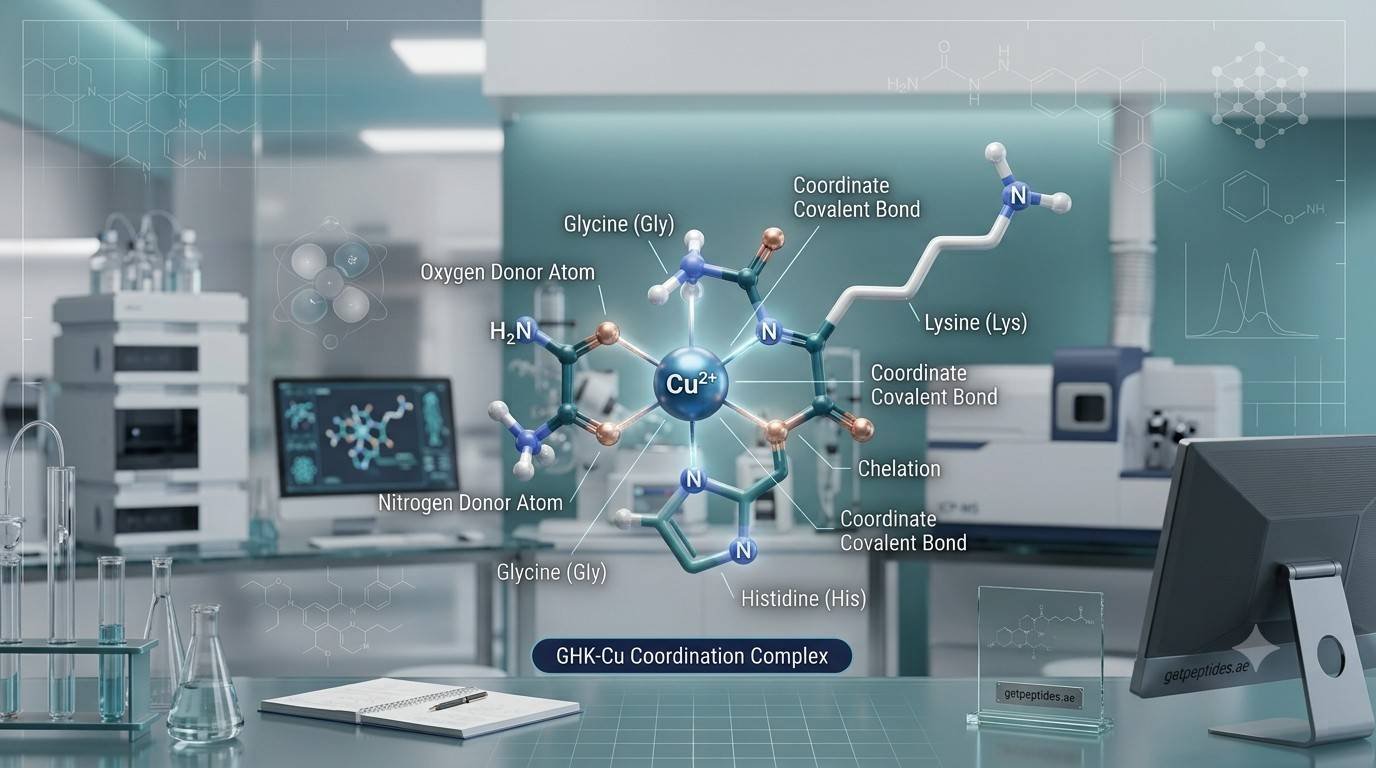
Copper peptides are among the most widely discussed metal–peptide complexes in biochemical research. A well-known example is GHK-Cu, a complex formed when the naturally occurring tripeptide GHK (glycyl-L-histidyl-L-lysine) binds with a copper(II) ion. Understanding copper peptides coordination chemistry provides insight into how peptides and metal ions interact at the molecular level. Rather than viewing copper simply as a free metal ion, coordination chemistry explains how binding to a peptide creates a new chemical complex with distinct structural and physicochemical properties.
What Is Coordination Chemistry?
Coordination chemistry is the branch of chemistry that studies how metal ions interact with surrounding molecules or ions known as ligands. A ligand donates one or more pairs of electrons to a metal ion, forming a stable coordination complex.
In biological systems, amino acids and peptides frequently act as ligands because they contain atoms such as nitrogen and oxygen capable of binding metal ions. This process, often called chelation, can stabilize the metal and alter its chemical behavior.
Copper(II), represented as Cu²⁺, is particularly well suited for coordination because it readily forms complexes with molecules containing amino and imidazole groups.
The GHK Tripeptide
The GHK tripeptide consists of three amino acids:
- Glycine
- Histidine
- Lysine
Although small, this peptide contains several potential metal-binding sites. The histidine residue is especially important because its imidazole ring provides a strong nitrogen donor atom capable of coordinating with copper(II).
When GHK encounters copper ions under appropriate conditions, the peptide acts as a multidentate ligand, binding the metal through multiple donor atoms to form the well-characterized GHK-Cu complex.
How GHK Binds Copper(II)
The interaction between GHK and copper(II) is an example of tripeptide-metal binding. Multiple atoms within the peptide cooperate to coordinate a single Cu²⁺ ion, creating a stable metal-peptide complex.
In simplified terms, the coordination process involves:
- Copper(II) approaching the peptide.
- Nitrogen atoms from the peptide donating electron pairs.
- Formation of coordinate covalent bonds.
- Stabilization of the resulting coordination complex.
This chelation process differs significantly from weak ionic attraction. Instead, the copper ion becomes integrated into the molecular structure of the peptide, producing a defined coordination environment.
Because several donor atoms participate simultaneously, the complex is generally more stable than one formed by a single ligand interaction.
Why the Complex Behaves Differently from the Free Peptide
A peptide alone and its corresponding metal complex do not necessarily share identical chemical properties.
When GHK binds copper(II), several characteristics can change, including:
- Molecular geometry
- Electronic structure
- Spectroscopic behavior
- Stability in solution
- Coordination environment
These differences arise because the copper ion influences electron distribution throughout the complex. The resulting metal-peptide complex exhibits properties that are distinct from both free GHK and free copper ions.
From an analytical chemistry perspective, this illustrates why coordination compounds are treated as unique chemical entities rather than simple mixtures of their individual components.
Analytical Measurement of Copper Content
Characterizing copper peptides requires analytical techniques capable of measuring both elemental composition and molecular structure.
Common laboratory methods include:
| Technique | Purpose |
|---|---|
| ICP-MS (Inductively Coupled Plasma Mass Spectrometry) | Quantifies total copper content |
| Mass Spectrometry | Confirms molecular identity |
| UV-Visible Spectroscopy | Evaluates metal–ligand interactions |
| HPLC | Assesses sample purity and composition |
Among these, ICP-MS is widely used for highly sensitive elemental analysis because it can accurately measure trace levels of copper within research samples.
These analytical methods help researchers verify product consistency and characterize coordination complexes under controlled laboratory conditions.
Frequently Asked Questions
What is a copper peptides?
A copper peptides is a coordination complex formed when a peptide binds a copper ion. One of the best-known examples is GHK-Cu, in which the tripeptide GHK coordinates with copper(II).
How does GHK bind copper?
GHK binds copper through donor atoms present within its amino acid residues, particularly the histidine side chain. These atoms donate electron pairs to copper(II), forming a stable coordination complex through chelation.
What is coordination chemistry?
Coordination chemistry is the study of how metal ions form complexes with surrounding ligands. In biological chemistry, peptides frequently serve as ligands that bind metals such as copper, zinc, and iron.
Conclusion
Understanding copper peptides coordination chemistry provides valuable insight into how peptides interact with metal ions at the molecular level. The GHK-Cu complex demonstrates how a naturally occurring tripeptide can chelate copper(II) to form a stable coordination complex with properties distinct from the free peptide or metal ion alone. From ligand binding and coordination geometry to analytical characterization using techniques such as ICP-MS and mass spectrometry, coordination chemistry remains an important area of biochemical and inorganic research.
As with all research materials, discussions of copper peptides should focus on their chemical structure, analytical characterization, and laboratory investigation. Products supplied by GetPeptides.ae are intended for laboratory research use only and are not intended for human or veterinary use.