

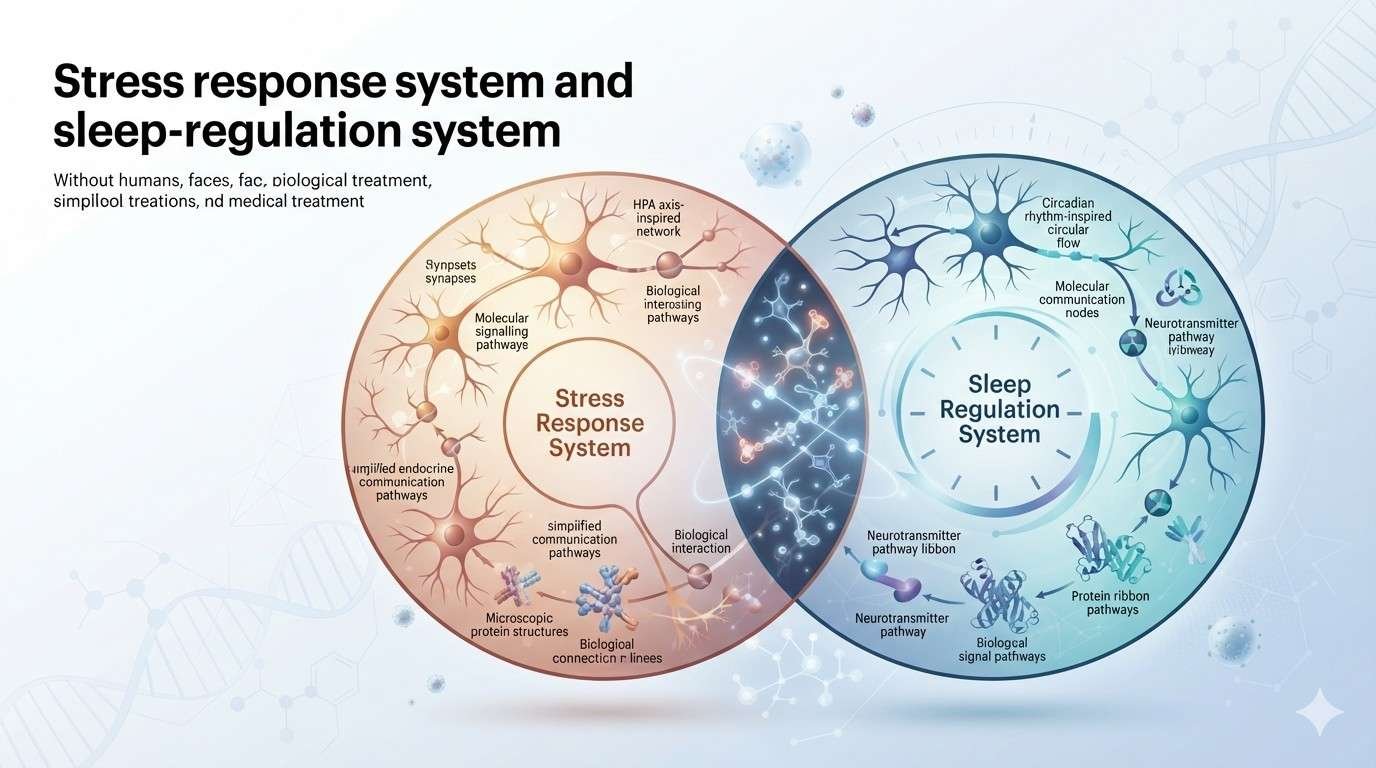
Few biological systems are as tightly linked as the ones that govern stress and sleep. Most people know the connection from experience: a demanding day is often followed by a restless night, and a restless night can make the next day feel heavier. Beneath these everyday observations sits a network of hormones, neural circuits, and timing signals that neuroscience research has mapped for decades. This article offers a neutral, first-principles overview of stress and sleep biology explained through the systems involved, not through any product or intervention.
The Stress-Response System (HPA Axis)
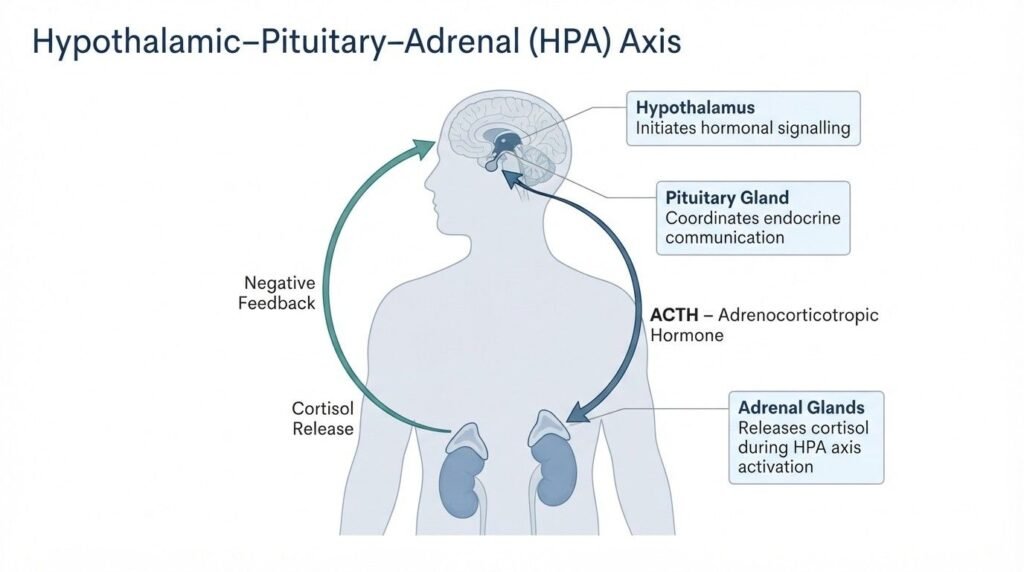
At the center of the stress response is the hypothalamic-pituitary-adrenal axis, usually shortened to the HPA axis. Think of it as a relay. When the brain registers a challenge, the hypothalamus releases a signalling molecule that prompts the pituitary gland to release another. That second signal travels to the adrenal glands, which release cortisol, a hormone laboratory investigations frequently use as a readable marker of the stress response.
Cortisol is not simply an “alarm” chemical. It follows a predictable daily pattern, or cortisol rhythm, typically rising in the early morning and tapering across the day. The HPA axis also includes a feedback loop: rising cortisol signals back to the brain to ease further release, a form of biological self-regulation. This feedback is one expression of homeostasis, the body’s tendency to hold internal conditions within a workable range.
Working alongside the HPA axis is the autonomic nervous system, which balances “activating” and “calming” branches. Researchers often study how these two systems coordinate, because the stress response is rarely the work of a single pathway acting alone.
Sleep Regulation and Circadian Rhythm
Sleep is governed by two broad influences that scientists describe as complementary. The first is a “pressure” system: the longer wakefulness lasts, the more the drive for sleep accumulates. The second is timing, set by the circadian rhythm, an internal roughly-24-hour clock coordinated by a small region of the hypothalamus and synchronized largely by light.
Sleep regulation depends on molecular signalling that shifts across this daily cycle. Melatonin, released as evening light fades, is one well-studied timing signal. A family of neuropeptides and neurotransmitters also participates, adjusting the balance between wake-promoting and sleep-promoting circuits. Neuroscience research treats sleep not as a passive “off” state but as an actively regulated sequence of stages, each with distinct electrical and chemical signatures.
Where the Two Systems Intersect
The stress and sleep systems are not separate machines; they share hardware. The hypothalamus helps direct both the HPA axis and the circadian clock, so the same brain region sits at the crossroads of stress signalling and sleep timing. The cortisol rhythm and the sleep-wake cycle are also normally aligned, which is why disruptions in one are studied as potentially connected to shifts in the other.
This overlap is why researchers frequently examine the two systems together rather than in isolation. Molecular interactions at shared receptors, the timing of hormone release, and the influence of the autonomic nervous system on both stress and rest are all active areas of biological study.
Related Research Material Laboratory groups studying neuropeptide signalling in stress-response and circadian models sometimes reference combined research compounds such as the AC-Selank + Delta Sleep (DSIP) research blend. Provided strictly for laboratory research and educational context — not for human or animal use.
Why Researchers Study This Interaction
The stress-sleep relationship is a useful model system for several fields. For neuroscientists, it offers a way to study how hormonal signalling (the HPA axis) and neural timing (the circadian clock) coordinate through shared molecular pathways. For those studying receptor biology, it raises questions about how the same signalling molecules influence multiple circuits.
Compounds studied in this space, including neuropeptides in the Selank and delta-sleep families, are used in laboratory investigations as tools to probe these pathways. In a research setting, the interest is mechanistic: what receptors are involved, how signals propagate, and how the systems maintain homeostasis. This is also why stress physiology and sleep physiology are so often measured together in experimental design.
Frequently Asked Questions
What is the HPA axis in simple terms? It is a hormonal relay connecting the hypothalamus, pituitary gland, and adrenal glands. It coordinates the stress response, largely through the release of cortisol.
How is the circadian rhythm different from sleep pressure? The circadian rhythm is an internal clock that sets timing across roughly 24 hours. Sleep pressure is a separate drive that builds up the longer an organism stays awake. Both influence sleep regulation.
Why is cortisol described as having a rhythm? Cortisol levels follow a daily pattern, typically higher in the morning and lower at night. Researchers study this cortisol rhythm as a marker of HPA-axis activity.
What role do neuropeptides play here? Neuropeptides are signalling molecules that act on receptors in the brain. Neuroscience research studies how various neuropeptides participate in both stress-response pathways and sleep-related circuits.
Why do scientists study stress and sleep together? The two systems share brain regions and signalling pathways, and their daily rhythms are normally aligned. Studying them together reflects how they actually operate in biology.
Stress and Sleep Biology Conclusion
The stress and sleep systems are best understood as two connected parts of one regulatory whole. The HPA axis manages the stress response through cortisol and feedback control; the circadian rhythm and sleep-regulation circuits manage the timing and structure of rest. Because they share the hypothalamus, overlapping signalling molecules, and closely aligned daily rhythms, neuroscience research continues to examine them as an integrated system governed by homeostasis. Approached from first principles, the relationship is less about cause-and-effect folk wisdom and more about how biological signalling pathways coordinate across time.
Continue Exploring This Topic For readers examining neuropeptide signalling in stress-response and circadian research models, the AC-Selank + Delta Sleep (DSIP) research blend is one reference compound studied in this laboratory context. For research and educational purposes only.
This article is educational and reflects laboratory research context only. It does not provide medical advice, treatment guidance, or health recommendations.