

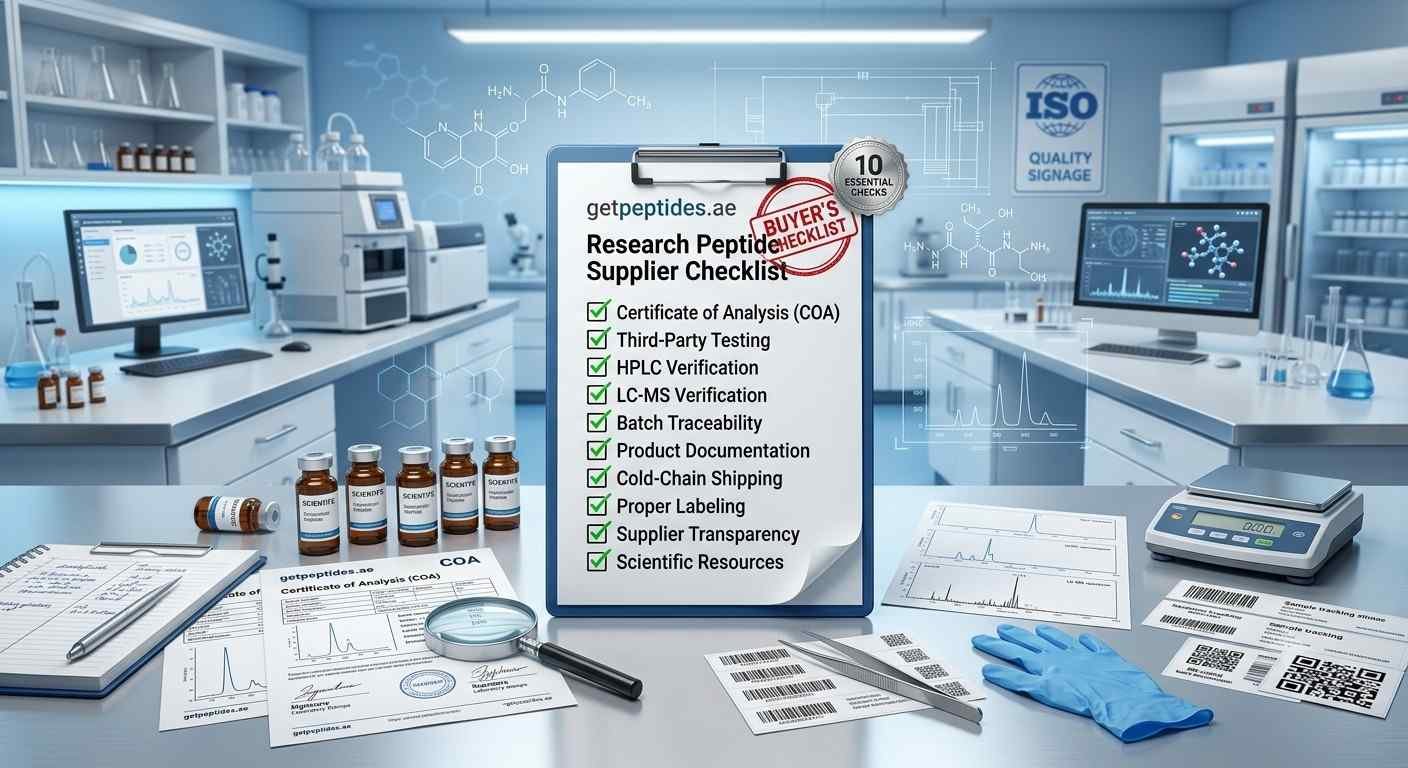
When laboratories buy research peptides, selecting the right supplier is about much more than price. Product quality, analytical documentation, batch consistency, and transparent manufacturing practices all influence the reliability of laboratory research materials.
A trustworthy research peptide supplier should be able to demonstrate how each product has been tested, documented, packaged, and shipped. These details help researchers evaluate whether laboratory materials meet the quality expectations required for scientific work.
Unfortunately, not every supplier provides the same level of transparency. Some publish detailed analytical reports and batch information, while others provide only limited documentation or vague quality claims. Knowing what to look for before placing an order can help laboratories make more informed procurement decisions.
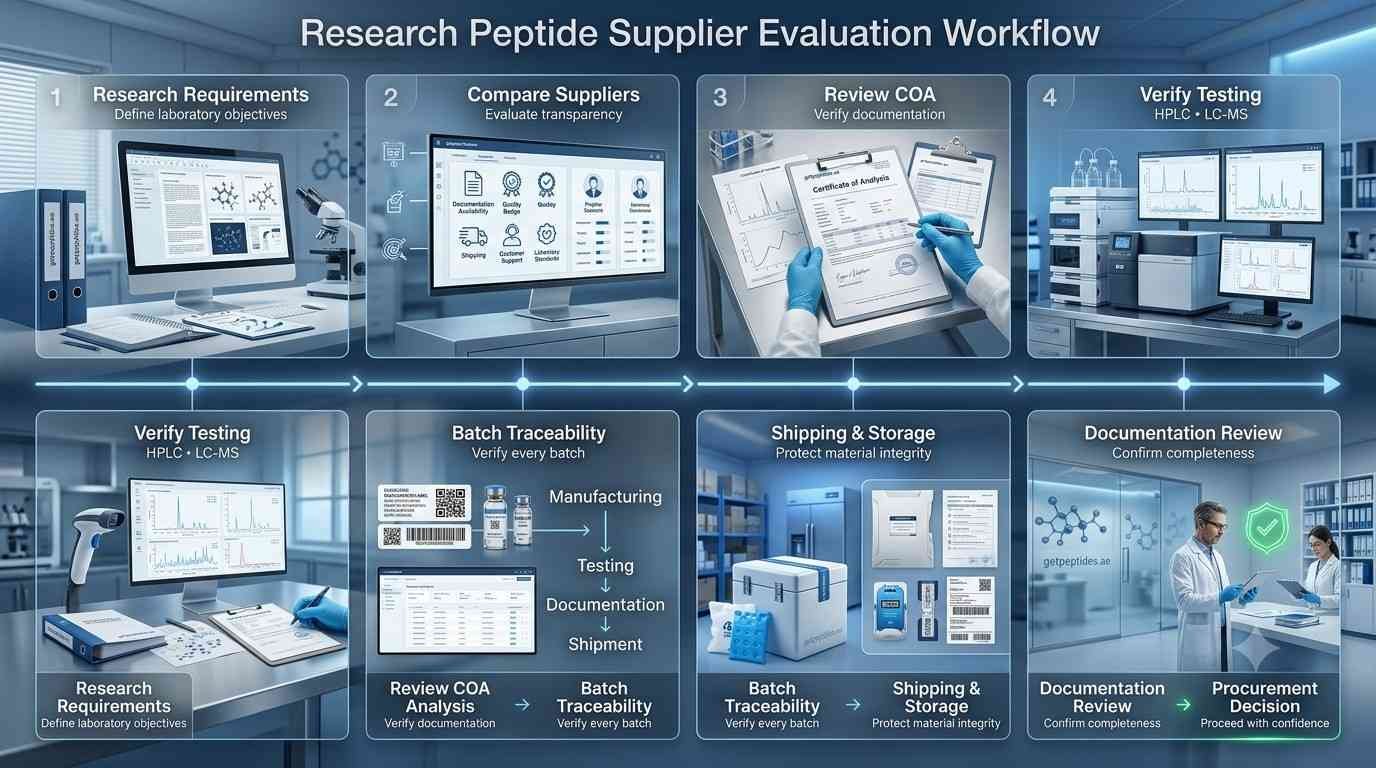
This guide presents a practical 10-point supplier checklist designed to help researchers evaluate any research peptide supplier—not just one company. Whether you’re comparing multiple vendors or reviewing a supplier for the first time, these criteria provide a structured way to assess documentation, quality standards, and operational transparency.
What should you check before buying research peptides?
Before purchasing research peptides for laboratory use, verify that the supplier provides batch-specific Certificates of Analysis (COAs), third-party testing where appropriate, validated analytical methods such as HPLC or LC-MS, complete product documentation, traceable batch numbers, appropriate cold-chain shipping practices when required, transparent labeling, responsive customer support, and educational resources explaining their quality standards.
Why Choosing the Right Supplier Matters
Many procurement decisions begin with comparing prices, but laboratory research materials should never be evaluated on cost alone. Consistency, documentation, analytical verification, and traceability often have a much greater impact on research quality than price differences.
A reliable supplier demonstrates quality through evidence rather than marketing language. Instead of broad statements such as “highest purity” or “premium grade,” reputable suppliers provide measurable documentation that researchers can independently review.
Below are several areas where supplier quality directly affects laboratory procurement.
Product Consistency
Research depends on reproducibility. When laboratories purchase research peptides, they expect products to remain consistent from one batch to another whenever possible.
Consistency begins with standardized manufacturing processes, documented analytical testing, and controlled quality assurance procedures. While every manufacturing batch has natural variation, suppliers should maintain clear specifications and provide batch-specific documentation.
Questions worth considering include:
- Are purity specifications clearly stated?
- Does every batch receive analytical testing?
- Are batch numbers unique and traceable?
- Are testing methods explained?
Suppliers that consistently publish this information make it easier for researchers to evaluate laboratory materials objectively.
Documentation
Documentation is one of the strongest indicators of supplier transparency.
A reputable research peptide supplier should provide more than a product description. Supporting documentation helps researchers understand how quality has been evaluated before products leave the laboratory.
Typical documentation may include:
- Certificate of Analysis (COA)
- Batch identification
- Product specifications
- Storage recommendations
- Packaging information
- Analytical methods used
- Manufacturing or quality statements where appropriate
Well-organized documentation also simplifies internal laboratory recordkeeping and procurement reviews.
Traceability
Every laboratory material should be traceable back to a specific production batch.
Batch traceability allows laboratories to identify exactly which analytical reports correspond to a purchased product. If additional testing or quality verification is required later, traceability provides a clear reference point.
Strong traceability typically includes:
| Quality Indicator | Why It Matters |
|---|---|
| Batch Number | Links products to analytical reports |
| Production Date | Supports inventory management |
| Certificate of Analysis | Documents analytical results |
| Product Identification | Confirms product identity |
| Storage Information | Helps preserve material quality |
Traceability supports good laboratory practice and improves procurement confidence.
Shipping Practices
Shipping conditions are often overlooked during supplier evaluation.
Some laboratory research materials require temperature management or protective packaging to help preserve stability during transport. Suppliers should explain how products are packaged, how temperature-sensitive materials are handled when necessary, and what customers should do upon receipt.
Important considerations include:
- Protective packaging
- Temperature control (when applicable)
- Insulated shipping materials
- Shipment tracking
- Delivery documentation
Clear shipping procedures demonstrate that quality assurance extends beyond manufacturing.
Laboratory Confidence
Ultimately, supplier evaluation is about confidence.
Researchers should be able to answer questions such as:
- Can this supplier explain their testing process?
- Is documentation easy to verify?
- Are analytical reports complete?
- Are quality standards communicated clearly?
- Does the supplier provide educational resources instead of relying solely on marketing claims?
Suppliers that openly share quality information allow laboratories to make informed procurement decisions based on evidence rather than assumptions.
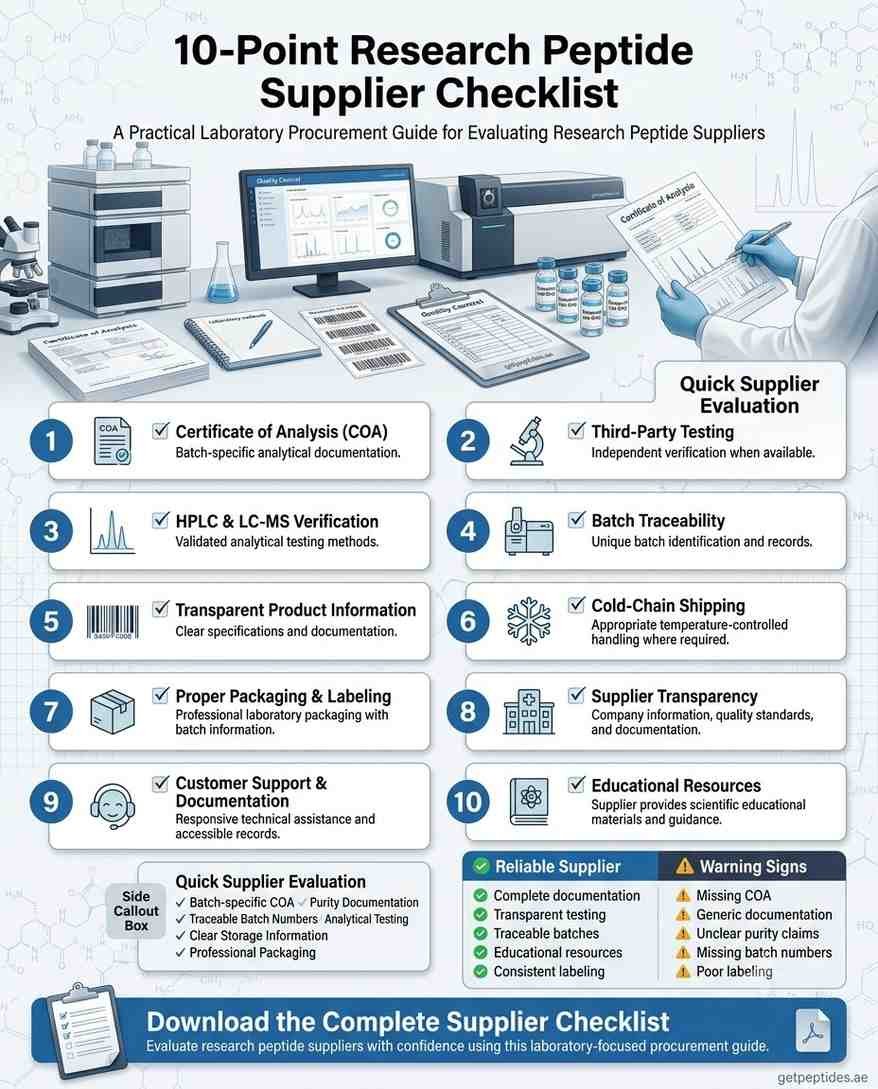
10 Things to Check Before Buying Research Peptides
Before reviewing individual suppliers, use this quick checklist as a starting point.
- ✔ Batch-specific Certificate of Analysis
- ✔ Independent or third-party testing information
- ✔ HPLC and/or LC-MS analytical verification
- ✔ Batch traceability
- ✔ Complete product specifications
- ✔ Appropriate shipping procedures
- ✔ Clear packaging and labeling
- ✔ Transparent supplier information
- ✔ Accessible customer support
- ✔ Educational resources explaining quality standards
The following sections explain each point in greater detail.
The Complete 10-Point Supplier Checklist
1. Certificate of Analysis (COA)
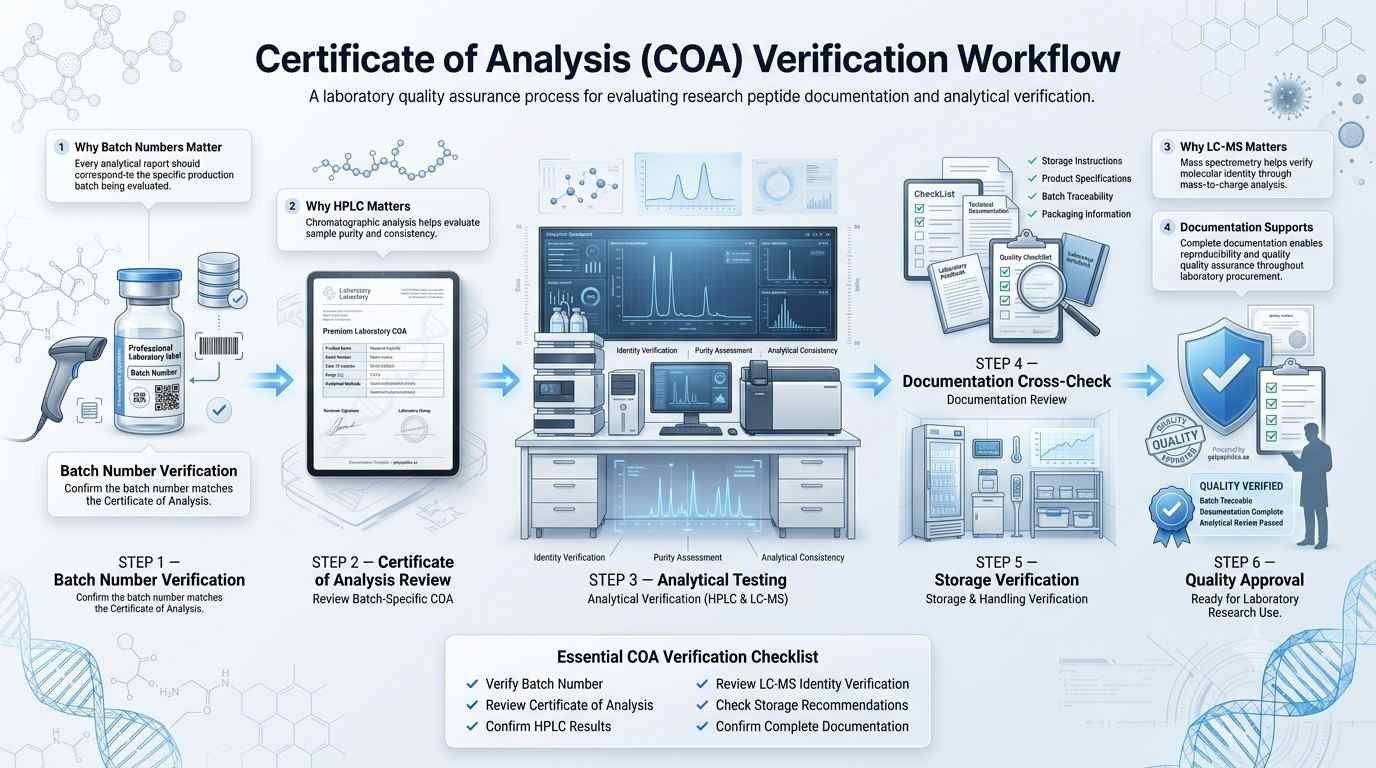
A Certificate of Analysis (COA) is one of the most important documents a research peptide supplier can provide. It summarizes analytical information about a specific production batch and allows laboratories to review how quality has been evaluated.
A COA should be batch-specific rather than generic. Generic certificates that are reused across multiple products or production lots provide far less value because they cannot be linked to a particular shipment.
Although formats differ between suppliers, a comprehensive COA commonly includes:
- Product name
- Batch or lot number
- Date of analysis
- Analytical methods used
- Purity results
- Identity confirmation
- Storage recommendations
- Laboratory approval or quality review
Researchers should also verify that the batch number printed on the product label matches the batch number shown on the Certificate of Analysis.
What to Look For
| Good Practice | Why It Matters |
| Batch-specific COA | Links documentation to the actual product received |
| Date of analysis | Shows testing occurred for that batch |
| Analytical methods listed | Improves transparency |
| Clear purity reporting | Supports quality evaluation |
| Matching batch numbers | Confirms traceability |
Common Warning Signs
- Generic certificates without batch numbers
- Missing analytical methods
- Unclear testing dates
- Incomplete documentation
- Poor-quality scans that omit important details
A Certificate of Analysis should help laboratories understand how quality was evaluated—not simply serve as a marketing document.
2. Third-Party Testing
Independent testing can provide an additional layer of confidence when evaluating laboratory research materials.
While manufacturers often perform their own analytical testing as part of quality control, some suppliers also obtain verification from independent laboratories. This external review may help confirm analytical results using separate equipment and quality systems.
Third-party testing does not automatically make one supplier better than another, nor is it always required for every procurement scenario. However, when available, independently generated analytical reports can strengthen transparency.
Researchers should look for suppliers that clearly explain:
- Whether testing was performed internally or externally
- Which laboratory conducted the analysis (when disclosed)
- Which analytical methods were used
- Whether reports correspond to the specific batch purchased
Internal Testing vs Third-Party Testing
| Internal Laboratory Testing | Third-Party Laboratory Testing |
| Performed by the manufacturer or supplier | Conducted by an independent laboratory |
| Part of routine quality control | Provides additional verification |
| Usually available for every batch | May be available for selected batches |
| Supports manufacturing consistency | Enhances transparency when documented |
The goal is not simply to see the phrase “third-party tested.” Researchers should review the supporting documentation and understand what testing was performed.
3. HPLC & LC-MS Verification
Analytical testing methods are central to laboratory quality evaluation.
Two of the most commonly referenced analytical techniques are High-Performance Liquid Chromatography (HPLC) and Liquid Chromatography–Mass Spectrometry (LC-MS).
Although these techniques are often mentioned together, they serve different purposes.
HPLC
HPLC is widely used to separate and analyze compounds within a sample. In research peptide quality control, HPLC commonly provides information related to chromatographic purity.
Researchers often review chromatograms to understand whether the sample appears consistent with stated purity specifications.
LC-MS
LC-MS combines chromatography with mass spectrometry.
While chromatography separates sample components, mass spectrometry helps verify molecular identity by measuring mass-to-charge ratios.
Because these techniques provide different information, they are often complementary rather than interchangeable.
HPLC vs LC-MS
| HPLC | LC-MS |
| Evaluates chromatographic purity | Helps confirm molecular identity |
| Produces chromatograms | Produces mass spectra |
| Common quality-control method | Common identity verification method |
| Useful for purity assessment | Useful for confirming expected molecular mass |
Researchers should avoid assuming that a single analytical result answers every quality question. Understanding what each method measures leads to more informed supplier evaluation.
4. Batch Traceability
Traceability allows laboratories to connect every research peptide to its production history.
A well-documented supplier should maintain records linking each batch to analytical testing, quality review, packaging, and shipment information.
This becomes especially valuable when:
- multiple orders are placed over time,
- laboratories compare different production batches,
- documentation must be reviewed during internal audits,
- analytical records need to be referenced later.
Key traceability elements include:
- Unique batch numbers
- Consistent labeling
- Corresponding Certificates of Analysis
- Production documentation
- Shipping records where applicable
Strong traceability reflects an organized quality management process rather than isolated testing.
5. Transparent Product Information
A product page should provide enough information for researchers to understand what is being purchased without relying on vague marketing language.
Clear product information generally includes:
- Product name
- Intended research use designation
- Quantity or presentation
- Storage recommendations
- Batch documentation availability
- Packaging details
- Analytical methods referenced
- Links to supporting educational resources
Be cautious of product pages that rely heavily on promotional language while offering little technical information. Transparency is demonstrated through specific, verifiable details rather than broad quality claims.
6. Cold-Chain Shipping
Shipping is an extension of quality assurance. Even well-documented laboratory research materials can be affected if they are packaged or transported inappropriately.
Not every research peptide requires the same shipping conditions. Recommended transport and storage requirements depend on the specific material, its formulation, packaging format, shipping duration, and environmental conditions. A reputable supplier should clearly explain how products are prepared for shipment and provide storage instructions upon delivery.
When evaluating a supplier, consider questions such as:
- Does the supplier explain how products are packaged?
- Are temperature-sensitive materials shipped with appropriate insulation when required?
- Is shipment tracking provided?
- Are storage instructions included with the order?
- Is there guidance for inspecting products upon arrival?
A transparent shipping process reduces uncertainty and helps laboratories handle incoming materials consistently.
What Good Shipping Practices Look Like
| Shipping Practice | Why It Matters |
|---|---|
| Protective packaging | Helps reduce physical damage during transit |
| Temperature management (when applicable) | Supports product stability during shipping |
| Tamper-evident packaging | Helps identify potential handling issues |
| Shipment tracking | Improves visibility throughout delivery |
| Storage instructions | Guides appropriate handling after receipt |
Receiving Checklist
When a shipment arrives, laboratories should:
- Inspect external packaging.
- Confirm product labels match the order.
- Verify batch numbers.
- Review the accompanying Certificate of Analysis.
- Follow the supplier’s storage recommendations as soon as practical.
- Document receipt according to internal laboratory procedures.
These simple steps help maintain traceability from delivery through laboratory storage.
7. Proper Packaging & Labeling
Packaging does more than protect a product during transport. It also communicates essential information needed for inventory management, traceability, and laboratory documentation.
Clear labeling allows researchers to identify materials quickly while reducing the risk of confusion between batches or products.
A well-labeled research peptide package commonly includes:
- Product name
- Batch or lot number
- Quantity
- Storage recommendations
- Research Use Only designation
- Supplier identification
Some suppliers may also include QR codes that link directly to Certificates of Analysis or batch documentation, making verification more efficient.
Labeling Checklist
| Label Element | Purpose |
| Product name | Identifies laboratory material |
| Batch number | Enables traceability |
| Quantity | Supports inventory control |
| Storage guidance | Assists proper handling |
| RUO statement | Clarifies intended laboratory use |
| Supplier details | Supports documentation and communication |
Packaging should also protect the contents from moisture, contamination, and unnecessary exposure during transportation and storage.
8. Supplier Transparency
Transparency is one of the easiest characteristics to evaluate because it is visible throughout a supplier’s website and documentation.
Trustworthy suppliers explain how they operate rather than expecting customers to rely solely on marketing claims.
Examples of transparent information include:
- Company background
- Laboratory quality practices
- Documentation policies
- Shipping procedures
- Frequently asked questions
- Contact information
- Quality assurance processes
- Educational resources
Transparency also means acknowledging limitations. For example, responsible suppliers clearly state that Research Use Only products are intended for laboratory research rather than making inappropriate claims about other uses.
Signs of a Transparent Supplier
- Detailed product documentation
- Clear quality standards
- Accessible contact information
- Educational content explaining laboratory concepts
- Consistent product information across the website
- Straightforward shipping and return policies
Researchers should be cautious when important information is difficult to locate or replaced with broad promotional language.
9. Customer Support & Documentation
Customer support is often overlooked during supplier evaluation, yet it can be valuable when laboratories need clarification about documentation, shipping, or analytical reports.
A knowledgeable support team should be able to answer technical procurement questions such as:
- Is a batch-specific Certificate of Analysis available?
- Which analytical methods were used?
- What storage conditions are recommended?
- How are batch numbers assigned?
- What documentation accompanies each shipment?
Support should focus on product documentation and laboratory handling rather than offering advice outside the intended research context.
Documentation Checklist
A reliable supplier should make it easy to obtain or access documentation such as:
- Certificate of Analysis
- Product specifications
- Batch identification
- Storage recommendations
- Shipping information
- Laboratory contact details
- Quality statements where applicable
Good documentation reduces delays and helps laboratories maintain complete procurement records.
10. Educational Resources & Scientific References
One of the strongest indicators of expertise is a commitment to education.
A supplier that invests in high-quality educational resources demonstrates an understanding that informed customers make better procurement decisions.
Useful educational content may include:
- Guides explaining Certificates of Analysis
- Articles about HPLC and LC-MS
- Storage best practices
- Research Use Only guidance
- Batch traceability explanations
- Laboratory procurement checklists
- Frequently asked questions
Educational resources should cite respected scientific references where appropriate rather than relying solely on internal claims.
Examples include publications indexed by PubMed, guidance from the National Institutes of Health (NIH), analytical chemistry literature, and technical information from organizations such as the U.S. Food and Drug Administration (FDA), European Medicines Agency (EMA), and the World Health Organization (WHO) when discussing general laboratory standards or scientific terminology.
Providing educational resources helps laboratories understand why certain quality practices matter instead of simply asking them to trust the supplier.
Red Flags to Watch For
While every supplier operates differently, certain warning signs deserve closer attention during the evaluation process.
Documentation Red Flags
- No Certificate of Analysis available
- Generic COAs without batch numbers
- Missing analytical methods
- Inconsistent product specifications
- Unclear purity reporting
Website Red Flags
- No company information
- No physical business details
- No contact methods beyond a simple web form
- Poorly written or duplicated product descriptions
- Missing shipping policies
Quality Red Flags
- Vague statements such as “highest quality” without evidence
- No explanation of testing procedures
- Missing batch traceability
- No storage guidance
- No quality documentation
Marketing Red Flags
Researchers should also be cautious of suppliers that make exaggerated claims, guarantee research outcomes, or imply uses inconsistent with Research Use Only products.
Reliable suppliers focus on documentation, transparency, and laboratory quality—not sensational marketing.
Questions to Ask Before Purchasing
Before choosing a research peptide supplier, consider asking these practical questions.
- Is a batch-specific Certificate of Analysis available?
- Which analytical methods were used to evaluate the product?
- Can the supplier explain their quality control process?
- Are batch numbers traceable?
- What storage conditions are recommended?
- How are products packaged for shipment?
- Is technical documentation available before purchase?
- How can I verify the authenticity of the supplied documentation?
- What happens if shipping is delayed?
- Where can I learn more about the supplier’s quality standards?
These questions help laboratories compare suppliers using objective criteria rather than marketing language.
Reliable Supplier vs Poor Supplier
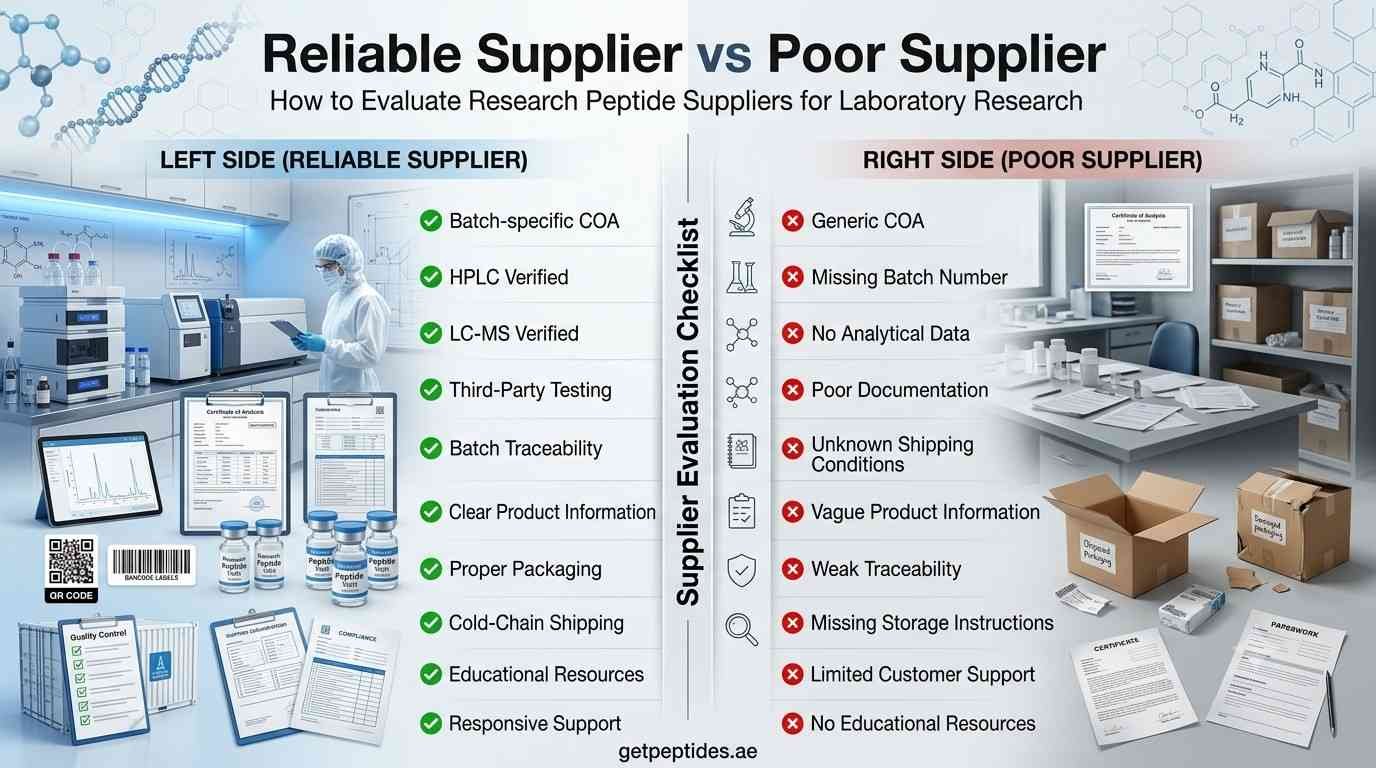
| Evaluation Area | Reliable Supplier | Poor Supplier |
| Certificate of Analysis | Batch-specific and complete | Generic or unavailable |
| Batch Traceability | Clearly documented | Difficult to verify |
| Testing Methods | HPLC, LC-MS, or other methods explained | Little or no testing information |
| Product Information | Detailed specifications | Minimal information |
| Storage Guidance | Clearly provided | Missing or vague |
| Packaging | Professional and protective | Limited details |
| Shipping Information | Transparent procedures | Little explanation |
| Educational Resources | Comprehensive guides | Mostly promotional content |
| Customer Support | Documentation-focused assistance | Limited technical knowledge |
| Transparency | Clear policies and company information | Important information difficult to find |
No supplier will be identical, but consistent transparency across these categories generally reflects stronger quality management practices.
Download the Free Supplier Checklist
A structured checklist can make supplier comparisons faster and more consistent, especially when evaluating multiple vendors.
Consider creating a printable one-page evaluation sheet that includes:
- Certificate of Analysis review
- Batch number verification
- Analytical testing methods
- Documentation availability
- Product specifications
- Packaging assessment
- Shipping procedures
- Storage recommendations
- Supplier transparency
- Educational resources
A downloadable PDF checklist also provides laboratories with a repeatable procurement workflow that can be used for future purchasing decisions.
Lead Magnet Suggestion: Offer the checklist as a downloadable PDF in exchange for an email address. Keep the document concise, printable, and suitable for laboratory procurement records.
Frequently Asked Questions
1. How do I choose a research peptide supplier?
Choosing a research peptide supplier should involve more than comparing prices or product availability. Start by reviewing the supplier’s documentation, including batch-specific Certificates of Analysis (COAs), analytical testing methods, and product specifications. Look for transparent information about quality control, storage recommendations, shipping procedures, and customer support.
A reliable supplier should make it easy for laboratories to verify quality through documentation rather than relying on broad marketing claims.
2. What should a Certificate of Analysis (COA) include?
A Certificate of Analysis should be specific to the production batch being supplied.
Typical information includes:
- Product name
- Batch or lot number
- Date of analysis
- Analytical methods (such as HPLC or LC-MS)
- Reported analytical results
- Storage recommendations
- Laboratory approval or quality review, where applicable
Researchers should verify that the batch number on the product label matches the batch number listed on the COA.
3. What is peptide purity?
Peptide purity refers to the proportion of the analyzed sample that corresponds to the intended peptide under the analytical method used.
Purity is commonly evaluated using chromatographic techniques such as High-Performance Liquid Chromatography (HPLC). While purity is an important quality indicator, it should always be interpreted alongside identity verification, batch documentation, and other analytical results rather than in isolation.
4. Is HPLC testing enough to evaluate research peptides?
HPLC is an important analytical technique because it helps evaluate chromatographic purity, but it does not answer every quality question.
Many laboratories also use complementary methods such as Liquid Chromatography–Mass Spectrometry (LC-MS) to help verify molecular identity. Because these techniques measure different characteristics, they often provide a more complete analytical picture when considered together.
5. Why is third-party testing valuable?
Third-party testing provides an additional level of independent verification when available.
An external laboratory may confirm analytical results using its own instruments and quality systems, helping researchers review information from more than one source. Although not every supplier uses third-party laboratories for every batch, suppliers should clearly explain what testing has been performed and provide supporting documentation whenever possible.
6. What does “Research Use Only” (RUO) mean?
“Research Use Only” (RUO) indicates that a product is intended strictly for laboratory research and analytical purposes.
RUO materials are not intended for human use, veterinary use, therapeutic use, diagnostic use, or any clinical application unless specifically authorized under applicable regulations. Laboratories should always use research materials according to applicable institutional policies and regulatory requirements.
7. Why is batch traceability important?
Batch traceability allows laboratories to connect every purchased product to its analytical documentation.
This supports:
- Inventory management
- Internal quality systems
- Procurement documentation
- Future reference during laboratory reviews
- Verification of Certificates of Analysis
Strong traceability helps laboratories maintain organized records throughout the procurement process.
8. What should product labels include?
Clear product labeling supports proper identification and inventory management.
A well-prepared label typically includes:
- Product name
- Batch number
- Quantity
- Storage recommendations
- Research Use Only statement
- Supplier identification
These details reduce confusion and make it easier to connect physical inventory with analytical documentation.
9. How should research peptides be stored?
Storage recommendations vary depending on the specific laboratory research material and should always follow the supplier’s documentation.
Researchers should review:
- Storage temperature recommendations
- Packaging instructions
- Handling guidance after delivery
- Protection from environmental conditions when applicable
Following documented storage instructions helps preserve the integrity of laboratory research materials during storage and handling.
10. What makes a trustworthy research peptide supplier?
Trustworthy suppliers demonstrate transparency through documentation rather than marketing language.
Key indicators include:
- Batch-specific Certificates of Analysis
- Clearly explained analytical testing
- Batch traceability
- Comprehensive product documentation
- Appropriate shipping practices
- Accessible customer support
- Educational resources
- Transparent quality standards
The more information researchers can independently verify, the more informed their procurement decisions can be.
Conclusion
Choosing where to buy research peptides should involve careful evaluation of documentation, analytical testing, traceability, and supplier transparency—not simply comparing prices.
A reliable research peptide supplier should provide evidence that supports laboratory procurement decisions. Batch-specific Certificates of Analysis, clearly described analytical methods, traceable production records, and comprehensive product information all contribute to greater confidence in the materials being sourced.
The 10-point checklist presented in this guide offers a practical framework that laboratories can use when evaluating any supplier. Rather than relying on marketing claims, researchers can compare vendors using objective criteria that emphasize documentation, quality assurance, and operational transparency.
As scientific procurement standards continue to evolve, suppliers that prioritize openness, educational resources, and consistent quality practices are better positioned to support informed purchasing decisions for laboratory research.