


Research Peptides UAE: Ordering laboratory research materials involves much more than comparing prices or checking product availability. For laboratories working with research peptides in the UAE, procurement decisions affect documentation, traceability, quality assurance, storage practices, and the integrity of future research activities.
Whether sourcing a single peptide or managing routine laboratory procurement, researchers should understand how to evaluate suppliers, review quality documentation, verify analytical testing, and maintain appropriate storage conditions throughout the product lifecycle.
Research peptides are often supplied as highly specialized laboratory materials. Because of this, laboratories should establish procurement procedures that prioritize transparency, consistency, and complete batch documentation. Choosing suppliers that provide clear analytical reports and traceable records helps support reproducibility and internal quality systems.
What should laboratories know before ordering research peptides?
Before ordering research peptides in the UAE, laboratories should verify that suppliers provide batch-specific Certificates of Analysis (COAs), analytical testing such as HPLC and Mass Spectrometry, clear storage instructions, traceable batch information, appropriate packaging, and reliable shipping procedures. A structured procurement process helps laboratories maintain quality standards and documentation from ordering through storage.
This guide explains each of these areas in detail, providing a practical framework that laboratories can use when evaluating research peptide suppliers.
What Are Research Peptides?
Research peptides are laboratory research materials consisting of short chains of amino acids that are synthesized for scientific investigation, analytical testing, method development, and experimental research. They are commonly used in academic institutions, biotechnology laboratories, analytical laboratories, and other research environments where carefully characterized materials are required.
Depending on the project, laboratories may use research peptides for:
- Analytical method development
- Instrument calibration studies
- Assay validation
- Biochemical investigations
- Molecular interaction research
- Quality control procedures
- Laboratory training
- Scientific reference standards
Although the term “research peptide” is widely used, not every supplier provides the same level of quality documentation. This makes supplier evaluation an essential part of laboratory procurement.
Research Applications
Laboratories often require research peptides with clearly documented specifications so experiments can be reproduced consistently over time. Even small differences in purity, handling conditions, or storage history may influence analytical workflows or internal validation procedures.
For this reason, laboratories frequently assess several factors before purchasing laboratory research materials, including:
- Product identity
- Purity data
- Batch traceability
- Storage recommendations
- Analytical testing methods
- Packaging integrity
- Documentation completeness
Research teams also benefit from standardized procurement procedures that ensure every incoming batch is reviewed using the same quality criteria.
Laboratory Use Only
Research peptides supplied for laboratory research are intended solely for scientific, analytical, and educational applications.
They are not intended for:
- Human consumption
- Veterinary use
- Clinical use
- Therapeutic use
- Diagnostic use unless specifically validated for that purpose
Laboratories should always follow their organization’s internal procurement policies, laboratory safety procedures, and applicable regulatory requirements when ordering and handling research materials.
Why Supplier Selection Matters
Choosing a supplier is more than selecting a company that can ship a product. A reliable supplier supports laboratory quality systems by providing transparent documentation, consistent manufacturing information, and traceable analytical records.
A well-documented procurement process also helps laboratories maintain confidence in incoming materials, simplifies inventory management, and supports future audits or internal quality reviews.
Rather than focusing on a single specification such as purity percentage, laboratories should evaluate suppliers across several quality indicators.
Quality Systems
Reliable suppliers generally operate within structured quality management processes that emphasize consistency, documentation, and traceability.
When reviewing a supplier, laboratories may wish to consider whether information is available regarding:
- Manufacturing controls
- Batch consistency
- Quality assurance procedures
- Analytical verification
- Product labeling standards
- Packaging procedures
- Storage recommendations
While manufacturing standards and certifications vary among suppliers, transparent communication about quality systems often reflects a stronger commitment to documentation and reproducibility.
Documentation
Documentation is one of the most important indicators of supplier quality.
A supplier should make essential product information available before or alongside shipment whenever appropriate.
Examples include:
- Certificate of Analysis (COA)
- Batch identification
- Product specifications
- Analytical testing summary
- Recommended storage conditions
- Handling guidance
- Product labeling information
Complete documentation helps laboratories verify that incoming materials match procurement requirements before they are introduced into inventory.
Traceability
Traceability refers to the ability to identify and follow a product throughout its lifecycle.
For laboratory research materials, traceability supports:
- Inventory management
- Batch comparisons
- Internal audits
- Repeat ordering
- Investigation of analytical differences
- Laboratory quality systems
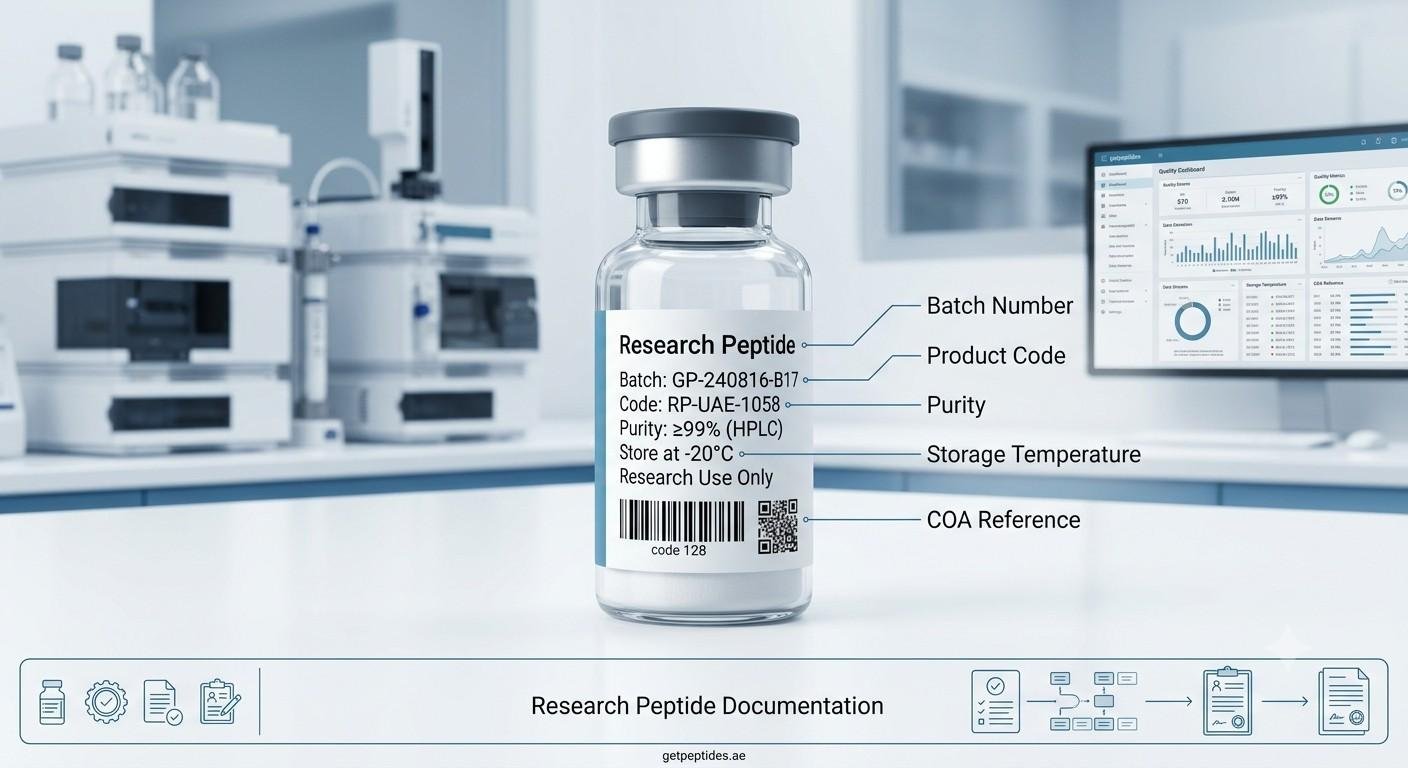
A traceable product typically includes identifiers such as:
| Traceability Element | Why It Matters |
|---|---|
| Batch Number | Identifies the manufacturing lot |
| Product Code | Distinguishes product variants |
| Manufacturing Date (where available) | Supports inventory management |
| Certificate Number | Links documentation to the product |
| Storage Recommendation | Helps preserve product integrity |
| Packaging Information | Assists receiving inspections |
Maintaining accurate records from receipt through storage reduces uncertainty and improves consistency across laboratory operations.
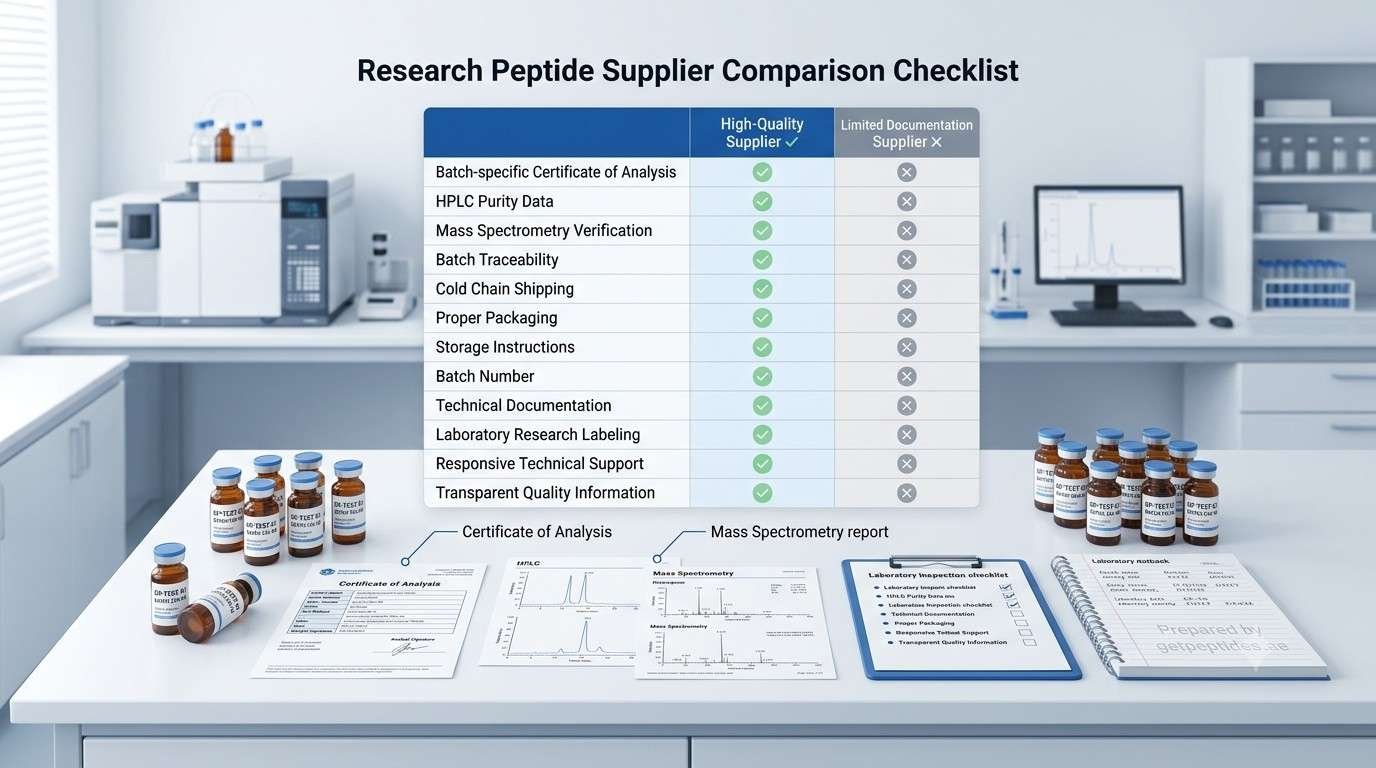
Documents Every Laboratory Should Request
Documentation forms the foundation of laboratory procurement. Even when products appear identical, supporting records provide the evidence laboratories need to evaluate identity, quality, and traceability.
Before placing an order, laboratories should confirm which documents are available and whether they are specific to the batch being supplied.
Certificate of Analysis (COA)
A Certificate of Analysis (COA) is one of the most valuable documents provided with laboratory research materials.
Rather than serving as a marketing document, a COA summarizes analytical information associated with a specific production batch.
Although formats vary between suppliers, a well-prepared COA commonly includes:
- Product name
- Batch number
- Lot identification
- Purity result
- Analytical methods used
- Storage recommendations
- Date of analysis
- Authorized review or approval
Laboratories should verify that the COA corresponds to the exact batch received rather than relying on generic documentation.
Purity Reports
Purity information helps laboratories understand the composition of a research peptide sample based on the analytical methods performed.
Purity values are commonly determined using techniques such as High-Performance Liquid Chromatography (HPLC). These reports provide context about the analyzed sample but should always be interpreted alongside other analytical data and the supplier’s documentation.
When reviewing purity information, laboratories may consider:
- Reported purity percentage
- Analytical methodology
- Date of analysis
- Batch identification
- Relationship to the accompanying COA
Purity alone should not be used as the only purchasing criterion. Complete documentation provides a more comprehensive picture of product quality.
Batch Information
Batch-specific records allow laboratories to distinguish one production lot from another.
Recording batch information supports:
- Inventory control
- Repeat purchasing
- Internal quality reviews
- Experimental documentation
- Material traceability
At a minimum, laboratories should document:
- Batch number
- Product code
- Date received
- Supplier
- Storage location
- Associated COA
Maintaining these records can simplify future procurement decisions and strengthen laboratory documentation practices.
Storage Instructions
Even high-quality laboratory research materials can be affected by improper storage after delivery.
Clear storage instructions supplied by the manufacturer help laboratories establish consistent handling procedures immediately upon receipt.
Storage documentation may include recommendations regarding:
- Temperature
- Protection from moisture
- Light exposure
- Packaging after opening
- Long-term storage considerations
Laboratories should incorporate these recommendations into their own standard operating procedures (SOPs) where appropriate.
Supplier Documentation Checklist
Before confirming an order, laboratories should verify that the supplier can provide:
- Batch-specific Certificate of Analysis
- Analytical testing summary
- Purity information
- Batch number
- Product identification
- Storage recommendations
- Packaging information
- Shipping documentation where applicable
- Contact information for technical inquiries
- Clear laboratory research use labeling
Using a standardized checklist during procurement helps ensure consistency across purchasing decisions and reduces the likelihood of missing important documentation.
Understanding Peptide Quality
Selecting laboratory research materials involves more than checking a product description or purity percentage. Quality is built through a combination of analytical testing, manufacturing consistency, documentation, traceability, and proper handling throughout the supply chain.
Laboratories should evaluate research peptides using multiple quality indicators rather than relying on a single specification. This approach supports reproducibility and reduces uncertainty when introducing new materials into research workflows.
HPLC Analysis
High-Performance Liquid Chromatography (HPLC) is one of the most widely used analytical techniques for assessing the purity of research peptides.
During HPLC analysis, components within a sample are separated as they pass through a chromatography column. The resulting chromatogram helps identify the presence of the target peptide and any detectable impurities under the conditions used for analysis.
While HPLC is commonly used for purity assessment, laboratories should remember that analytical methods have defined scopes and limitations. Results should always be interpreted together with supporting documentation rather than in isolation.
What an HPLC Report Typically Includes
A supplier’s HPLC report may contain:
- Product name
- Batch number
- Sample identification
- Chromatogram
- Reported purity percentage
- Testing conditions
- Date of analysis
- Analyst or laboratory reference
When comparing suppliers, laboratories should consider whether reports appear batch-specific rather than generic examples.
Mass Spectrometry
Mass Spectrometry (MS) is another commonly used analytical technique for confirming molecular identity.
Unlike HPLC, which focuses primarily on separation and purity assessment, Mass Spectrometry measures the molecular mass of compounds. When used together, these techniques provide complementary analytical information.
In laboratory procurement, Mass Spectrometry documentation helps support confidence that the supplied material corresponds to the expected molecular composition.
Why Identity Verification Matters
Identity confirmation contributes to:
- Batch verification
- Material traceability
- Internal quality systems
- Research reproducibility
- Supplier transparency
Laboratories should look for documentation that clearly associates analytical results with the specific batch supplied.
Understanding Purity Percentages
Purity percentages are often one of the first specifications laboratories review, but they should never be considered independently.
For example, two products may both report similar purity values while differing significantly in documentation quality, traceability, storage recommendations, or analytical reporting.
Instead of asking only:
“What purity percentage does this product have?”
A more useful question is:
“What evidence supports this reported purity?”
Factors to Review Alongside Purity
| Quality Indicator | Why It Matters |
|---|---|
| HPLC Report | Demonstrates analytical purity assessment |
| Mass Spectrometry | Supports molecular identity confirmation |
| Batch Number | Enables traceability |
| Certificate of Analysis | Links analytical data to the supplied material |
| Storage Instructions | Helps maintain product integrity |
| Packaging Information | Protects material during transport |
A complete quality evaluation combines these elements into a broader assessment rather than focusing on one numerical value.
Quality Assessment Checklist
Before approving incoming laboratory research materials, laboratories should verify:
- Batch-specific Certificate of Analysis
- HPLC analytical data
- Molecular identity confirmation where available
- Batch number consistency
- Product labeling
- Packaging integrity
- Storage recommendations
- Shipping condition documentation
- Supplier contact information
Using a standardized review process helps ensure consistency across procurement activities.
Storage Best Practices
Proper storage begins the moment laboratory research materials are received.
Even well-characterized products can be compromised if stored outside the manufacturer’s recommended conditions. Establishing consistent storage procedures helps laboratories preserve documentation integrity and reduce unnecessary handling risks.
Because storage recommendations vary depending on the product, laboratories should always follow the supplier’s instructions provided with each batch.
Temperature
Temperature management is one of the most important aspects of laboratory storage.
Upon receipt, laboratory personnel should:
- Review storage recommendations.
- Inspect packaging for damage.
- Record receipt information.
- Transfer materials promptly to the appropriate storage environment.
Avoid leaving temperature-sensitive materials at room temperature longer than necessary during receiving procedures.
Many laboratories document:
- Storage location
- Storage temperature
- Date received
- Date placed into storage
- Responsible personnel
These records strengthen inventory control and quality management.
Moisture Protection
Many laboratory research materials are supplied in lyophilized (freeze-dried) form because this supports stability during storage and transportation.
Moisture exposure may affect laboratory materials depending on the product and handling procedures.
To reduce unnecessary exposure:
- Keep containers sealed until required.
- Minimize repeated opening.
- Handle materials in accordance with laboratory SOPs.
- Store products in dry environments as recommended.
- Return materials to storage promptly after handling.
Consistent handling procedures reduce avoidable variability during laboratory operations.
Light Exposure
Some laboratory materials should be protected from prolonged light exposure.
Suppliers may recommend:
- Amber containers
- Protective secondary packaging
- Storage in enclosed laboratory freezers or cabinets
Always refer to the accompanying documentation rather than applying general storage assumptions.
Inventory Management
Effective procurement extends beyond ordering—it includes accurate inventory control throughout the product’s lifecycle.
Laboratories benefit from maintaining records such as:
| Inventory Record | Purpose |
| Product Name | Inventory identification |
| Batch Number | Traceability |
| Date Received | Inventory tracking |
| Storage Location | Material retrieval |
| Quantity Remaining | Stock management |
| Associated COA | Documentation reference |
Good inventory practices simplify repeat ordering and internal audits while reducing the risk of documentation errors.
Storage Best Practices Checklist
Laboratories should:
- Review supplier storage recommendations immediately upon receipt.
- Record batch numbers.
- Maintain inventory logs.
- Protect materials from unnecessary temperature fluctuations.
- Reduce repeated handling.
- Keep documentation associated with each batch.
- Inspect storage conditions regularly.
- Follow internal SOPs for laboratory research materials.
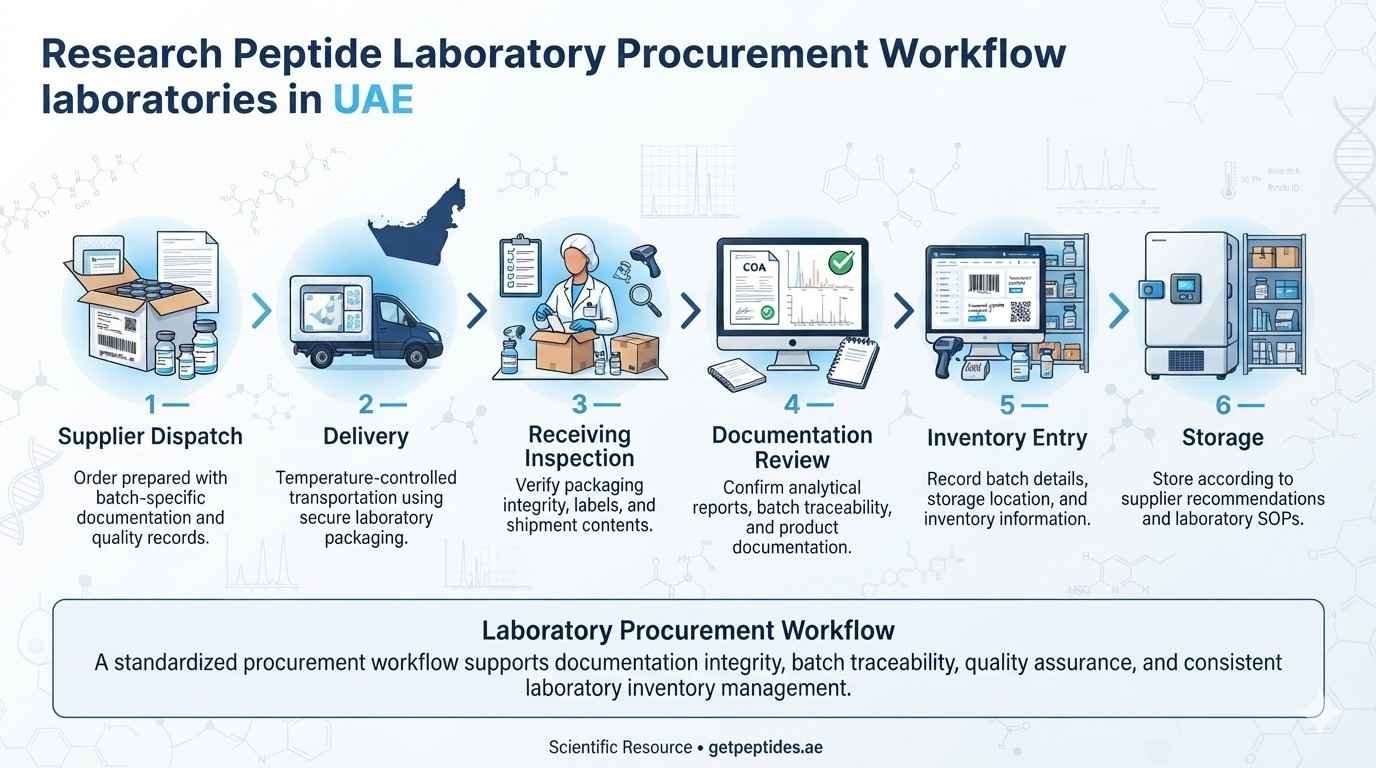
Shipping and Logistics in the UAE
Shipping laboratory research materials requires careful planning to help preserve product quality during transport.
In the UAE, laboratories should evaluate logistics alongside analytical documentation when selecting a supplier. Reliable delivery procedures support consistent procurement and reduce delays during receiving.
Cold-Chain Shipping
Some laboratory research materials may require temperature-controlled transportation depending on the product specifications and storage recommendations.
Cold-chain logistics generally involve:
- Insulated packaging
- Temperature-appropriate shipping materials
- Transit planning
- Packaging designed to reduce environmental exposure
Laboratories should confirm shipping arrangements before placing an order, particularly when ordering materials with specific storage requirements.
Packaging
Protective packaging serves several important functions during transportation.
Appropriate packaging may include:
- Clearly labeled vials
- Secondary containment
- Protective cushioning
- Moisture-resistant materials
- Batch identification labels
- Shipping documentation
Packaging should also help laboratories identify incoming materials quickly during receiving inspections.
Receiving Inspection
Receiving inspection is an important but sometimes overlooked step in laboratory procurement.
Materials should be reviewed promptly after delivery to verify that the shipment matches the purchase documentation.
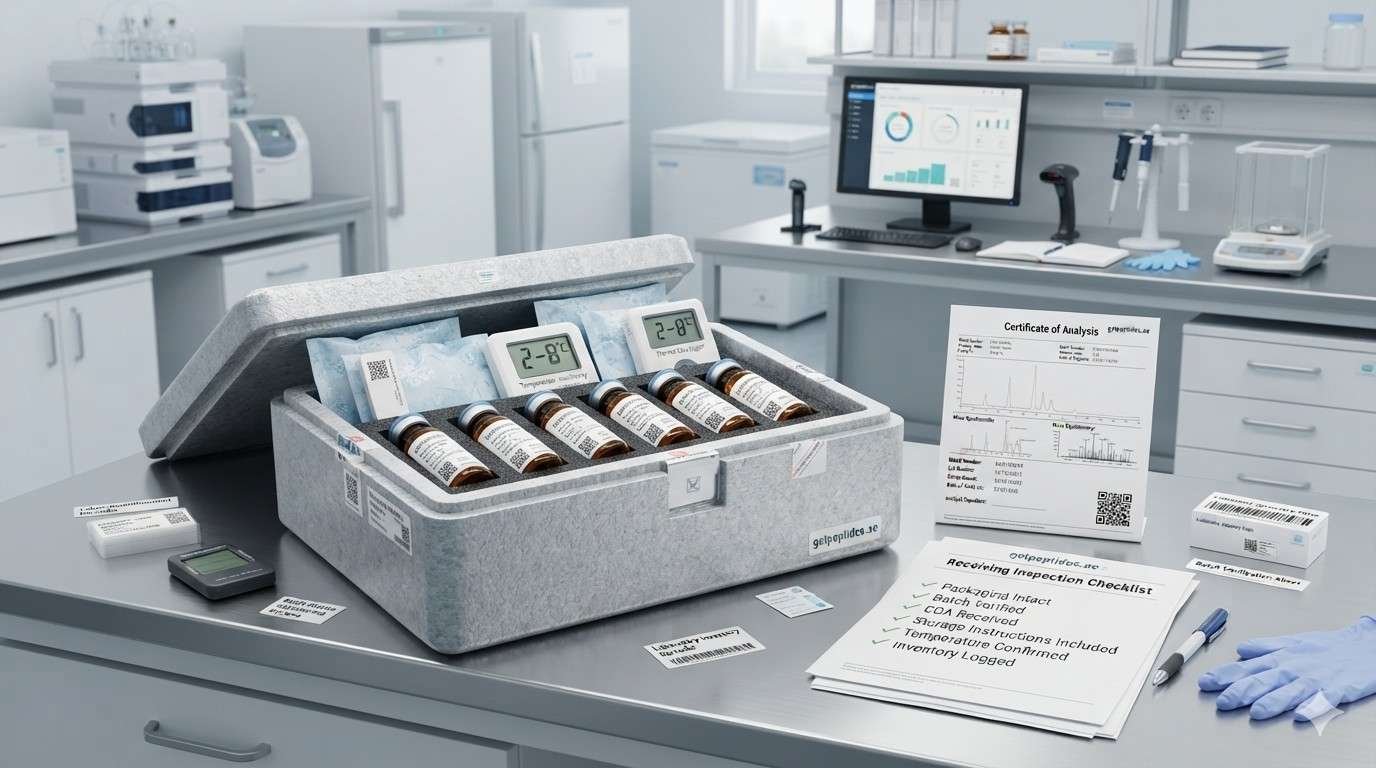
Receiving Inspection Checklist
Upon arrival, laboratory personnel should confirm:
- Correct product received
- Packaging intact
- Labels legible
- Batch numbers match documentation
- Certificate of Analysis included
- Quantity matches purchase order
- Storage instructions available
- Shipping documentation complete
Recording these checks immediately helps establish a complete procurement record.
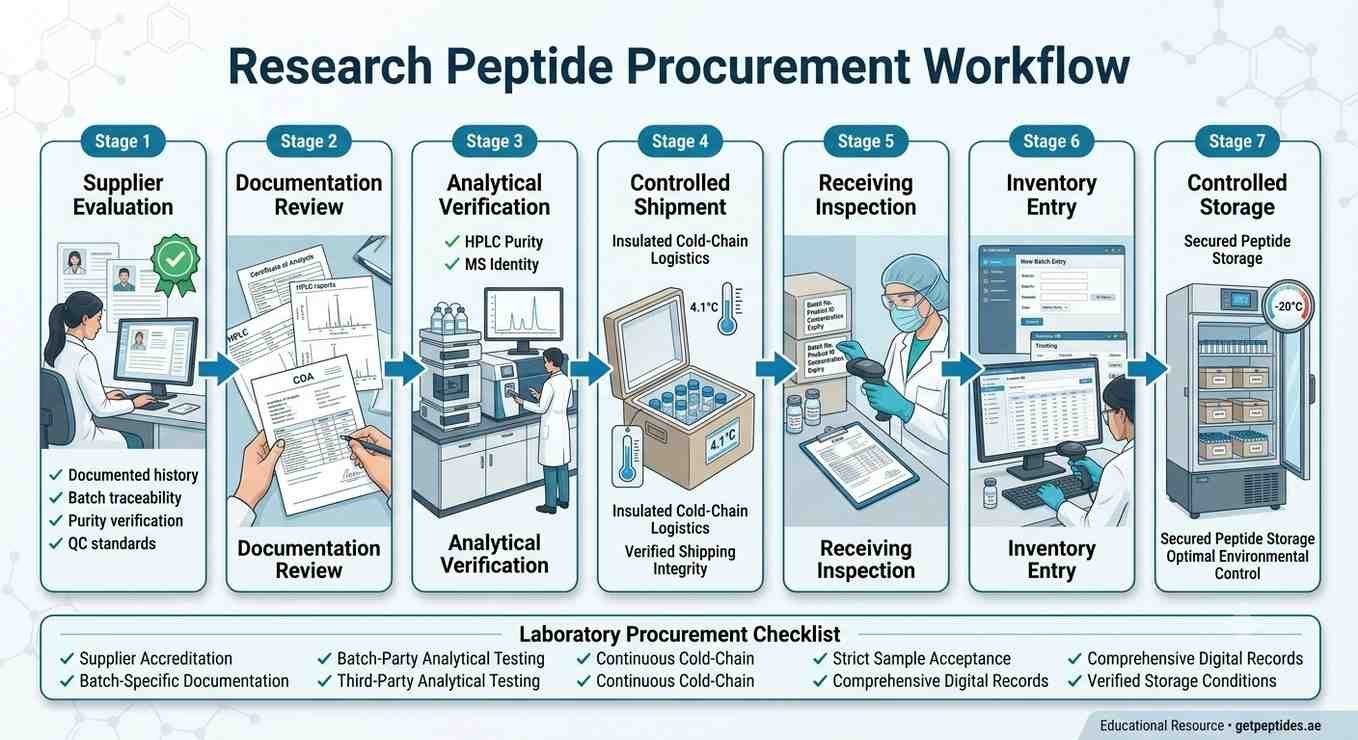
Laboratory Procurement Workflow
- Select an appropriate supplier.
- Review available documentation.
- Verify analytical reports.
- Confirm storage recommendations.
- Place the order.
- Review shipment documentation.
- Perform receiving inspection.
- Record batch information.
- Store materials according to recommendations.
- Maintain documentation for future reference.
This structured workflow supports consistency across laboratory purchasing activities.
Questions Laboratories Should Ask Suppliers
Selecting a supplier should involve more than comparing product availability.
A structured supplier evaluation process helps laboratories identify organizations that prioritize documentation, traceability, and quality assurance.
Before placing an order, consider asking:
Documentation
- Is a batch-specific Certificate of Analysis provided?
- Are HPLC reports available?
- Is molecular identity confirmed where applicable?
- Are analytical reports linked to the supplied batch?
Quality
- How is batch consistency maintained?
- What quality assurance procedures are followed?
- Are products clearly labeled?
- What documentation accompanies each shipment?
Shipping
- How are temperature-sensitive materials packaged?
- What shipping options are available within the UAE?
- What measures help protect products during transport?
Storage
- What storage conditions are recommended?
- Are handling instructions included?
- Are long-term storage recommendations provided?
Clear answers to these questions help laboratories compare suppliers using objective criteria rather than marketing claims.
Common Procurement Mistakes
Laboratory procurement processes become more reliable when common mistakes are identified and avoided.
Below are several issues laboratories should watch for during supplier evaluation and receiving.
Mistake 1: Reviewing Only Purity Percentage
Purity is important, but it represents only one aspect of quality documentation.
Always review supporting analytical evidence and traceability information.
Mistake 2: Ignoring Batch Traceability
Without batch records, future comparisons and internal documentation become more difficult.
Every shipment should be associated with identifiable batch information.
Mistake 3: Overlooking Storage Guidance
Improper storage after delivery may affect laboratory materials.
Review supplier recommendations immediately after receipt and integrate them into laboratory SOPs where appropriate.
Mistake 4: Accepting Incomplete Documentation
A shipment should include the documentation needed to support laboratory records.
Missing analytical reports or incomplete Certificates of Analysis should be addressed before materials are introduced into inventory.
Mistake 5: Skipping Receiving Inspection
Receiving inspections help identify discrepancies while shipment information is still readily available.
A standardized receiving checklist reduces documentation errors and strengthens inventory management.
Supplier Evaluation Comparison
| Good Supplier | Poor Supplier |
| Provides batch-specific COA | Generic documentation only |
| Includes HPLC data | No analytical information |
| Clear storage guidance | Limited handling instructions |
| Traceable batch identification | Missing batch records |
| Professional packaging | Minimal protective packaging |
| Transparent technical documentation | Limited product information |
| Responsive technical support | Difficult to obtain documentation |
Laboratories that evaluate suppliers using documented quality criteria are generally better positioned to maintain consistent procurement practices over time.
Laboratory Ordering Checklist
Ordering laboratory research materials should follow a standardized procurement process rather than an ad hoc purchasing decision. A documented workflow helps laboratories maintain consistency, supports internal quality systems, and ensures that essential documentation is reviewed before materials enter inventory.
The checklist below can be incorporated into laboratory Standard Operating Procedures (SOPs) or procurement documentation.
Pre-Order Evaluation
Before placing an order, confirm that the supplier can provide:
- Batch-specific Certificate of Analysis (COA)
- Product specifications
- HPLC analytical report (where applicable)
- Mass Spectrometry data (where applicable)
- Clear product identification
- Batch or lot number
- Recommended storage conditions
- Packaging details
- Shipping information
- Technical contact information
If any of these items are unavailable, laboratories should determine whether the missing documentation aligns with their internal procurement policies.
Supplier Qualification Checklist
Evaluate suppliers using objective quality criteria rather than marketing language.
| Evaluation Area | Questions to Consider |
|---|---|
| Documentation | Are batch-specific documents available? |
| Traceability | Can each shipment be linked to a unique batch? |
| Analytical Testing | Are analytical methods identified? |
| Storage Guidance | Are storage recommendations clearly documented? |
| Packaging | Is packaging suitable for laboratory transportation? |
| Technical Support | Can documentation-related questions be answered promptly? |
| Product Labeling | Are labels complete and easy to verify? |
Using a consistent supplier evaluation process helps laboratories compare vendors using measurable standards instead of promotional claims.
Receiving Checklist
Immediately after delivery, laboratory personnel should verify:
✓ Correct product received
✓ Quantity matches purchase order
✓ Batch numbers match documentation
✓ Packaging shows no visible damage
✓ Labels are legible
✓ Certificate of Analysis corresponds to the shipment
✓ Storage instructions are included
✓ Shipment documentation is complete
✓ Inventory records updated
✓ Materials transferred to appropriate storage promptly
Documenting these checks creates a traceable record from receipt through storage and supports future inventory reviews.
Laboratory Documentation Checklist
For every incoming batch, laboratories should maintain records including:
- Product name
- Supplier name
- Batch number
- Certificate of Analysis reference
- Date received
- Storage location
- Quantity received
- Internal inventory identifier (if applicable)
- Date placed into storage
- Personnel responsible for receiving
Maintaining complete documentation supports internal quality systems and simplifies repeat procurement.
Procurement Workflow Summary
- Identify laboratory requirements.
- Evaluate potential suppliers.
- Review analytical documentation.
- Verify batch-specific information.
- Confirm shipping and storage requirements.
- Place the order.
- Inspect the shipment upon arrival.
- Record inventory information.
- Store according to supplier recommendations.
- Maintain documentation for future reference.
Quick Procurement Summary
Research peptide procurement should focus on documentation, analytical verification, traceability, appropriate shipping, and proper storage—not simply product availability. A structured purchasing process helps laboratories maintain consistent quality standards throughout the procurement lifecycle.
Frequently Asked Questions
What are research peptides?
Research peptides are laboratory research materials composed of short chains of amino acids that are supplied for scientific, analytical, and educational applications. They may be used in laboratory investigations, assay development, analytical method validation, and other research activities depending on the objectives of the institution.
Products supplied for laboratory research should always be handled according to the supplier’s documentation and institutional laboratory procedures. They are not intended for human or veterinary use.
Are research peptides legal in the UAE?
Requirements may vary depending on the intended laboratory application, institutional policies, import procedures, and applicable regulations.
Organizations purchasing research peptides in the UAE should review current regulatory requirements, maintain appropriate procurement documentation, and ensure materials are acquired for legitimate laboratory research purposes only.
Because regulations can change, laboratories should verify current requirements with the appropriate authorities before ordering.
How should research peptides be stored?
Storage recommendations depend on the individual product and the supplier’s documentation.
Laboratories should always follow the storage conditions supplied with each batch. Recommendations may address factors such as temperature, moisture protection, packaging, and handling procedures.
Upon receipt, products should be transferred promptly to the recommended storage environment, and inventory records should be updated to support traceability.
What is a Certificate of Analysis (COA)?
A Certificate of Analysis (COA) is a batch-specific document that summarizes analytical information for a laboratory research material.
Although formats vary between suppliers, a COA commonly includes:
- Product identification
- Batch number
- Analytical methods
- Purity information
- Storage recommendations
- Date of analysis
Laboratories should confirm that the COA corresponds to the exact batch received rather than relying on generic documentation.
Why is HPLC purity important?
High-Performance Liquid Chromatography (HPLC) is widely used to assess the purity of laboratory research materials.
The reported purity value provides information about the analyzed sample under the conditions used during testing. However, laboratories should interpret HPLC results alongside other documentation such as Mass Spectrometry data, batch information, and the Certificate of Analysis.
Purity should be viewed as one component of an overall quality assessment rather than the sole purchasing criterion.
How are research peptides shipped?
Shipping methods depend on the product and supplier.
Laboratories should confirm:
- Packaging methods
- Temperature requirements
- Shipping documentation
- Transit procedures
- Storage recommendations upon arrival
Some laboratory research materials may require temperature-controlled transportation depending on supplier specifications.
Receiving personnel should inspect shipments promptly and compare delivered materials with purchase documentation.
What documents should laboratories request before ordering?
Before placing an order, laboratories should request documentation such as:
- Certificate of Analysis
- Batch information
- Product specifications
- Storage recommendations
- Analytical reports where available
- Product identification details
- Shipping information
Reviewing documentation before purchase helps laboratories evaluate supplier transparency and supports informed procurement decisions.
What is lyophilized peptide powder?
Lyophilization is a freeze-drying process commonly used during the preparation of certain laboratory research materials.
Removing water through lyophilization can assist with storage and transportation under appropriate conditions. Suppliers generally provide handling and storage recommendations that laboratories should follow for each specific product.
Laboratories should avoid making assumptions about storage requirements and instead rely on the accompanying documentation.
Why is batch traceability important?
Batch traceability allows laboratories to connect every product received with its associated documentation.
Maintaining batch records supports:
- Inventory management
- Internal audits
- Repeat ordering
- Documentation reviews
- Research reproducibility
- Quality management systems
Recording batch information immediately after receipt reduces the likelihood of documentation errors later.
What should laboratories check before accepting a shipment?
Receiving personnel should verify:
- Product identity
- Batch numbers
- Quantity received
- Packaging condition
- Product labels
- Certificate of Analysis
- Storage instructions
- Shipment documentation
Any discrepancies should be documented and reviewed before materials are incorporated into laboratory inventory.
How can laboratories evaluate a research peptide supplier?
A supplier evaluation should consider more than product availability.
Laboratories may assess:
- Documentation quality
- Batch traceability
- Analytical testing
- Packaging standards
- Storage guidance
- Technical support
- Shipping procedures
- Product labeling
Using standardized evaluation criteria helps create a consistent procurement process across multiple purchasing cycles.
What is the difference between product quality and documentation quality?
Product quality relates to the characteristics of the laboratory research material itself, while documentation quality refers to the records that support those characteristics.
For example, a supplier may report a purity value, but laboratories should also evaluate whether that value is supported by batch-specific analytical documentation, traceable records, and clear storage guidance.
Strong documentation improves transparency and supports laboratory quality systems, making it an essential part of procurement rather than an optional addition.
Conclusion
Sourcing research peptides involves much more than selecting a supplier with available inventory. For laboratories in the UAE, a well-structured procurement process should prioritize documentation, analytical transparency, traceability, appropriate storage, and reliable logistics at every stage of the ordering process.
Throughout this guide, we’ve explored the key elements laboratories should evaluate before purchasing laboratory research materials:
- Understand the purpose and intended laboratory use of the material.
- Review batch-specific Certificates of Analysis and analytical documentation.
- Verify quality indicators such as HPLC and, where available, Mass Spectrometry data.
- Confirm storage recommendations before products arrive.
- Inspect every shipment against purchase records and supporting documentation.
- Maintain accurate inventory and batch traceability throughout the product lifecycle.
When these practices become part of routine laboratory procurement, they help strengthen internal quality systems, improve recordkeeping, and support reproducible research workflows.
Rather than relying on marketing claims or isolated specifications, laboratories benefit from evaluating suppliers using objective criteria backed by transparent documentation. This approach aligns with widely accepted quality management principles and helps establish consistency across future purchasing decisions.
Whether a laboratory is ordering research peptides for the first time or refining an existing procurement process, documentation and traceability should remain central considerations from supplier selection through long-term storage.