


Buying peptides online is no longer limited to large institutions. Universities, contract research organizations, independent laboratories, and research facilities now have access to suppliers across multiple countries. While this provides greater choice, it also makes supplier evaluation more important than ever.
One of the common mistakes when buying peptides online is assuming that every supplier follows the same quality standards. In reality, documentation, analytical testing, storage practices, and shipping procedures can vary significantly between vendors.
Selecting laboratory research materials based only on price or marketing claims may introduce unnecessary uncertainty into a research workflow. Instead, researchers should evaluate objective quality indicators such as Certificates of Analysis (COAs), batch traceability, purity testing, cold-chain logistics, and supplier transparency.
This guide explains the most common purchasing mistakes and provides a practical quality verification framework that researchers can use before placing an order.
What are the most common mistakes when buying peptides online?
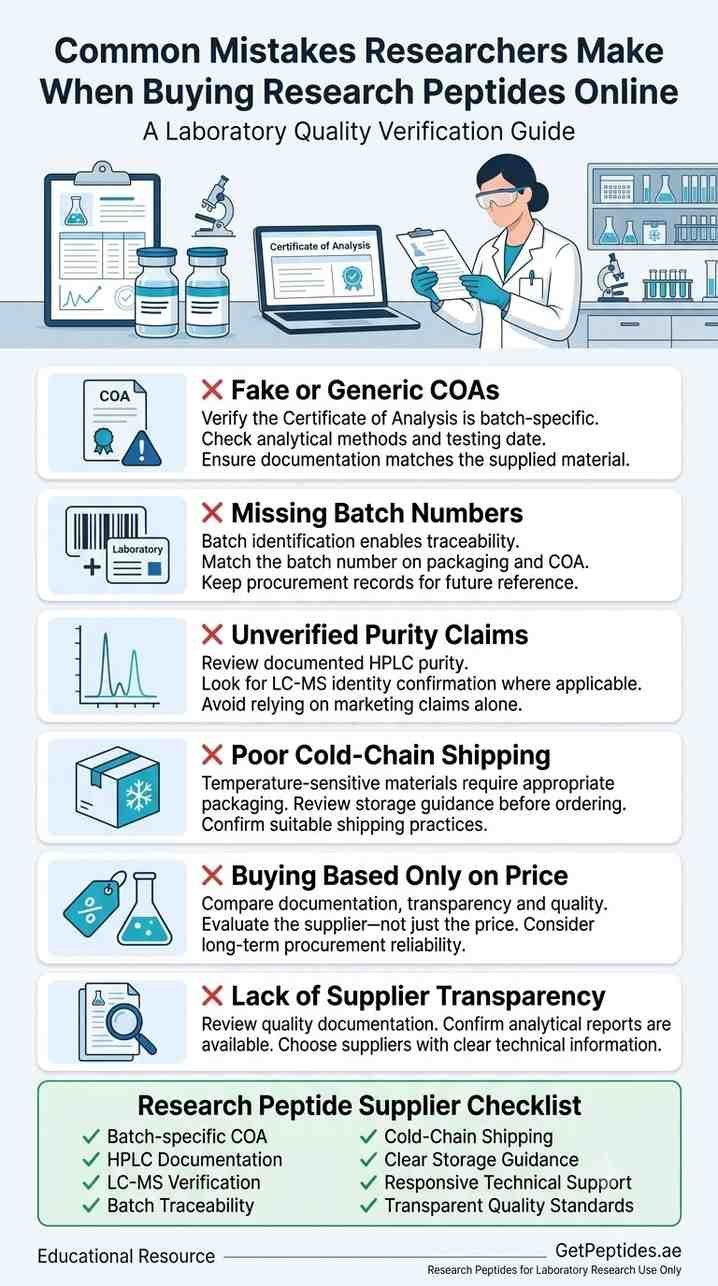
The most common mistakes when buying research peptides online include:
- Trusting every Certificate of Analysis without verification
- Ignoring batch or lot numbers
- Overlooking independent purity testing
- Choosing suppliers with poor cold-chain shipping practices
- Selecting vendors based only on price
- Buying from suppliers that provide limited documentation or transparency
Avoiding these issues helps laboratories improve procurement consistency and supports reliable research workflows.
Common Purchasing Mistakes at a Glance
- Fake or incomplete Certificates of Analysis
- Missing batch or lot numbers
- Unverified purity claims
- Inadequate cold-chain shipping
- Poor storage recommendations
- Limited supplier transparency
Why Peptide Quality Matters in Laboratory Research
Research peptides are valuable laboratory research materials used in analytical and experimental settings. Regardless of the research objective, consistent material quality is essential for reproducibility and documentation.
When evaluating suppliers, quality extends far beyond a product label. It includes the entire procurement process, from manufacturing documentation to shipping conditions and post-delivery storage recommendations.
Important quality indicators include:
- Batch-specific documentation
- Analytical testing reports
- Supplier traceability
- Appropriate packaging
- Stable shipping conditions
- Transparent communication
Each element contributes to the confidence researchers have in the materials entering their laboratory.
For this reason, experienced procurement teams often evaluate suppliers using standardized quality checklists instead of relying solely on product descriptions.
Why Documentation Matters
Documentation creates traceability.
Rather than accepting a supplier’s claims, researchers should be able to review objective records demonstrating that the supplied batch has undergone appropriate analytical testing.
Examples include:
- Certificate of Analysis
- Batch identification
- Analytical methods
- Purity reports
- Storage recommendations
- Manufacturing information where applicable
Complete documentation makes procurement decisions easier to justify and supports internal quality assurance procedures.
Supplier Evaluation Should Be Risk-Based
Not every project requires identical procurement standards. However, applying a structured evaluation process reduces uncertainty.
Questions researchers should consider include:
- Can this batch be traced?
- Is testing documentation available?
- Are analytical methods clearly stated?
- Is shipping appropriate for temperature-sensitive materials?
- Does the supplier explain storage recommendations?
Suppliers that answer these questions clearly generally provide greater transparency throughout the purchasing process.
Mistake #1 — Trusting Every Certificate of Analysis
One of the biggest misconceptions is that every Certificate of Analysis automatically proves product quality.
A Certificate of Analysis (COA) is an important quality document, but its value depends entirely on the information it contains and whether it corresponds to the specific batch being supplied.
Some suppliers provide detailed, batch-specific documentation. Others may display generic templates that contain limited information or cannot be linked to a particular production lot.
Researchers should never assume that all COAs offer the same level of verification.
What a Genuine COA Should Include
A well-prepared Certificate of Analysis generally contains information that allows researchers to understand exactly what has been tested.
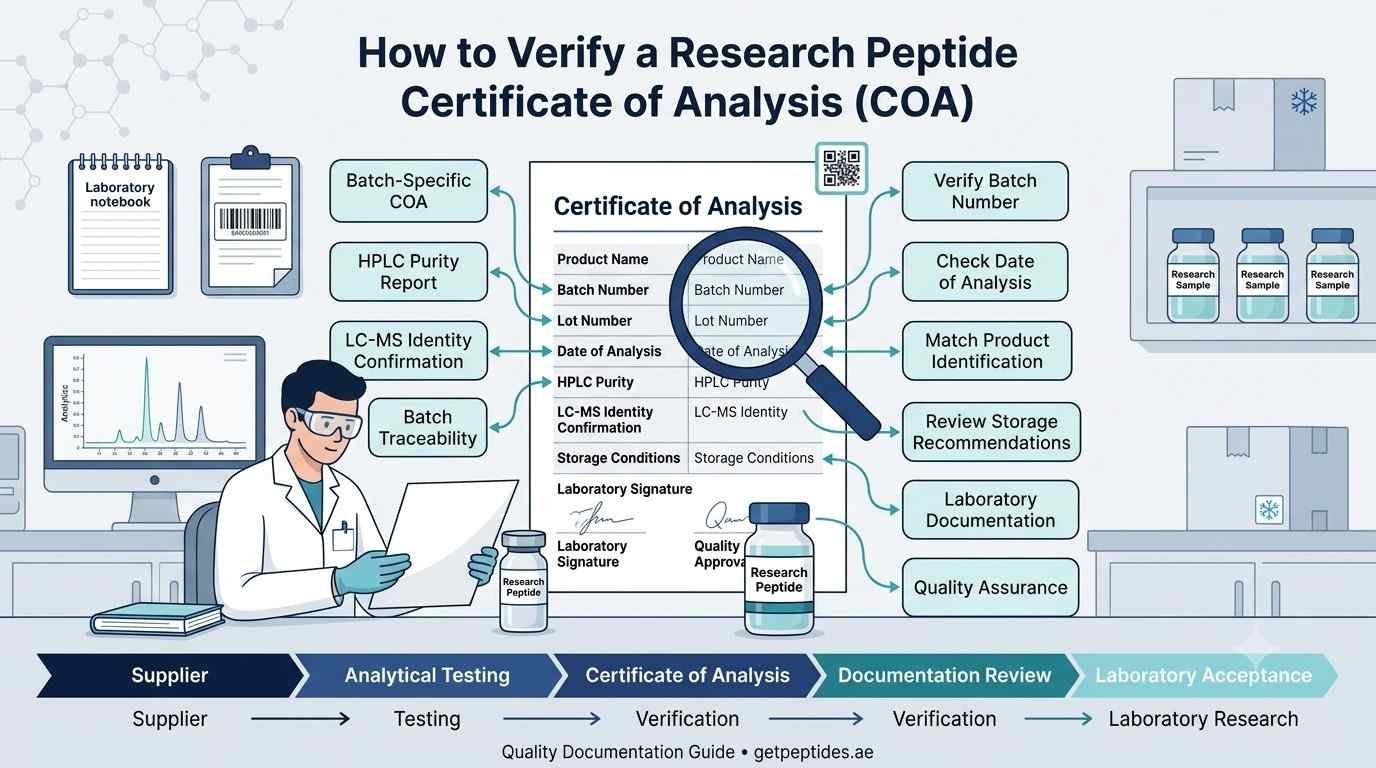
Although formats differ between laboratories, a comprehensive COA commonly includes:
| Information | Why It Matters |
|---|---|
| Product identification | Confirms the tested material |
| Batch or lot number | Enables traceability |
| Date of analysis | Indicates when testing occurred |
| Analytical methods | Explains how testing was performed |
| Purity results | Reports measured purity values |
| Identity confirmation | Supports product verification |
| Laboratory information | Identifies the testing laboratory |
Researchers should confirm that the batch number on the COA matches the batch received with the order.
Understanding Analytical Methods
Many research peptide suppliers reference analytical techniques such as:
- High-Performance Liquid Chromatography (HPLC)
- Liquid Chromatography-Mass Spectrometry (LC-MS)
These methods serve different purposes.
HPLC is commonly used to evaluate purity by separating components within a sample.
LC-MS combines chromatographic separation with mass analysis, providing additional confirmation of molecular identity.
When both methods are reported appropriately, researchers gain a more complete understanding of the analyzed material.
Batch-Specific Documentation Is Important
A COA should correspond to the actual batch supplied.
Generic documents without identifiable batch numbers reduce traceability and make it difficult to determine whether analytical testing applies to the purchased material.
Whenever possible, researchers should verify:
- matching batch numbers
- testing dates
- analytical methods
- product identity
Warning Signs of Questionable Documentation
Not every incomplete document is necessarily fraudulent, but missing information should encourage additional verification.
Potential warning signs include:
- No batch number
- No testing date
- Missing analytical methods
- Generic product descriptions
- No laboratory identification
- Inconsistent formatting
- Low-resolution documents with unreadable figures
- Identical COAs across multiple unrelated products
These issues do not automatically indicate poor quality, but they warrant further clarification before procurement.
Practical COA Verification Checklist
Before purchasing, review whether the supplier provides:
- Batch-specific Certificate of Analysis
- Analytical method description
- Purity report
- Testing date
- Product identification
- Laboratory details
- Storage guidance
- Batch traceability
This simple review takes only a few minutes but can significantly improve procurement confidence.
Mistake #2 — Ignoring Batch Numbers
Batch numbers may appear to be a small administrative detail, but they play a central role in laboratory quality systems.
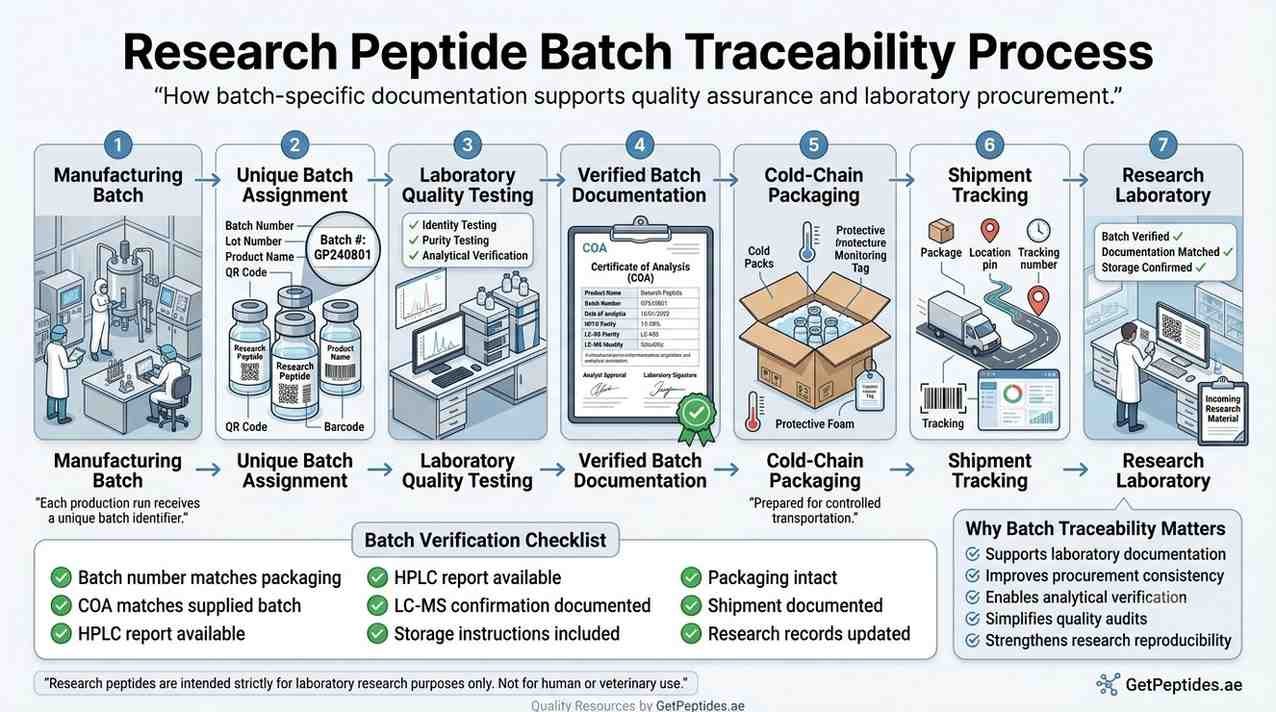
A batch number links a specific production run to its associated documentation, analytical testing, and quality records.
Without batch identification, it becomes difficult to determine exactly which material has been evaluated.
Why Batch Traceability Matters
Traceability allows laboratories to connect:
- manufacturing records
- analytical testing
- shipping documentation
- storage records
- procurement history
This information becomes especially valuable when comparing results across multiple research projects or repeat purchases.
If a laboratory orders the same research peptide at different times, batch identification makes it possible to determine whether the supplied material originated from different production runs.
Such documentation supports more consistent procurement practices.
Batch Number vs. Lot Number
These terms are sometimes used interchangeably, although definitions may vary between manufacturers.
| Batch Number | Lot Number |
|---|---|
| Identifies a specific production batch | Often used as an inventory or manufacturing identifier |
| Links analytical testing | Supports traceability |
| Appears on COAs | Appears on packaging and documentation |
Researchers should focus less on terminology and more on ensuring that identifiers remain consistent across all documentation.
How Researchers Can Verify Consistency
A simple verification process can improve purchasing confidence.
Before accepting a shipment:
- Check the label.
- Review the Certificate of Analysis.
- Confirm matching batch identifiers.
- Verify analytical testing dates.
- Document storage recommendations.
Maintaining these records supports internal quality assurance and simplifies future procurement reviews.
Why Repeatability Depends on Documentation
Consistency in laboratory procurement is not achieved through product descriptions alone.
Reliable documentation allows researchers to compare:
- analytical reports
- batch histories
- storage conditions
- procurement records
This information creates a stronger foundation for repeatable laboratory workflows.
Mistake #3 — Overlooking Purity Verification
Purity is one of the most frequently discussed characteristics of research peptides, yet it is also one of the most misunderstood.
A supplier may advertise a purity percentage, but responsible procurement requires understanding how that value was determined and whether supporting analytical documentation is available.
Purity results are most meaningful when they are tied to a specific batch and supported by recognized laboratory analytical methods rather than marketing claims alone.
In the next section, we’ll look at the two analytical techniques most commonly referenced in research peptide documentation—HPLC and LC-MS—and how researchers can interpret them during supplier evaluation.
Understanding HPLC
High-Performance Liquid Chromatography (HPLC) is one of the most widely used analytical techniques for evaluating the purity of research peptides. During HPLC analysis, the sample passes through a chromatography column where its components separate based on their chemical properties. The resulting chromatogram allows analysts to estimate the proportion of the target peptide relative to other detectable components.
For researchers, the important point is not simply that an HPLC result exists, but that it is:
- Batch-specific
- Performed using a documented analytical method
- Clearly reported in the Certificate of Analysis
- Consistent with the product identification
An HPLC purity value should always be interpreted within the context of the complete analytical report. Looking at a single percentage without supporting documentation provides only part of the quality picture.
What Researchers Should Look For
When reviewing an HPLC report, consider whether it includes:
- Batch or lot identification
- Date of analysis
- Chromatogram or summary results
- Reported purity value
- Testing laboratory information
- Method reference where applicable
A supplier willing to explain its analytical documentation generally demonstrates greater transparency than one providing only a headline purity claim.
Understanding LC-MS
Liquid Chromatography-Mass Spectrometry (LC-MS) combines chromatographic separation with mass analysis.
Where HPLC primarily evaluates purity, LC-MS helps confirm molecular identity by measuring the mass-to-charge ratio of detected compounds. Together, these techniques provide complementary information.
Think of them as answering different questions:
| Analytical Method | Primary Purpose |
|---|---|
| HPLC | Estimates sample purity |
| LC-MS | Confirms molecular identity |
Neither technique replaces the other. Instead, they contribute different pieces of information to the overall analytical profile.
For researchers comparing suppliers, documentation that includes both purity assessment and identity confirmation often provides greater confidence than documentation containing only a single analytical result.
Purity Claims Should Match Documentation
Researchers should be cautious when a supplier advertises specific purity values but provides no supporting analytical documentation.
Good procurement practice includes confirming that:
- The reported purity corresponds to the supplied batch.
- The analytical method is identified.
- Results appear internally consistent.
- Supporting documentation is available upon request when appropriate.
Transparent suppliers understand that researchers may wish to review this information before ordering.
Quick Comparison: Marketing Claims vs. Documented Quality
| Marketing Statement | Better Evidence |
| “Highest quality available” | Batch-specific analytical reports |
| “Premium peptides” | COA with documented testing methods |
| “Laboratory tested” | Clearly identified HPLC or LC-MS analysis |
| “Guaranteed purity” | Batch-linked analytical documentation |
| “Trusted supplier” | Transparent quality records and traceability |
Research procurement decisions should rely on verifiable information rather than promotional language.
Mistake #4 — Ignoring Cold-Chain Shipping
Even well-documented laboratory research materials can be affected by improper handling during transportation.
Shipping is often overlooked during supplier evaluation, yet it represents one of the most important stages in the supply chain. A supplier may invest heavily in analytical testing and quality control, but inadequate packaging or temperature management during transit can introduce unnecessary risk.
Researchers should evaluate not only what is being shipped, but also how it is reaches the laboratory.
Why Temperature Control Matters
Many laboratory research materials require controlled storage conditions to help preserve stability before use.
Depending on the product and its documented storage recommendations, suppliers may use insulated packaging, cold packs, dry ice, or other validated shipping methods to reduce temperature fluctuations during transport.
Researchers should avoid assuming that every product requires identical shipping conditions. Instead, they should review the supplier’s storage guidance and transportation practices for the specific material being ordered.
Temperature Sensitivity
Temperature fluctuations can occur during several stages of transportation:
- Warehouse storage
- Courier handling
- Customs processing
- Local delivery
- Final receipt at the laboratory
For international shipments, transit times may vary depending on customs clearance and logistics providers. Suppliers should account for these variables when selecting packaging methods.
Researchers can reduce procurement risk by asking suppliers questions such as:
- How is the product packaged for transit?
- What temperature protection is used?
- Is shipping validated for the destination region?
- Are storage recommendations included with the shipment?
These questions help establish whether temperature management has been considered as part of the supplier’s quality system.
Packaging Considerations
Protective packaging serves more than one purpose.
A well-designed shipping system may help:
- Reduce physical damage
- Minimize temperature variation
- Protect documentation
- Maintain clear product identification
- Prevent moisture exposure where appropriate
Packaging should also allow researchers to identify products easily upon arrival through clear labeling and batch identification.
Shipping Best Practices
Reliable suppliers typically communicate shipping expectations clearly before dispatch.
Best practices may include:
- Appropriate insulation based on shipping conditions
- Protective secondary packaging
- Clearly labeled storage instructions
- Batch identification on packaging
- Documentation enclosed or available digitally
- Shipment tracking where available
Not every shipment requires identical logistics, but suppliers should be able to explain why their chosen shipping method is appropriate for the products supplied.
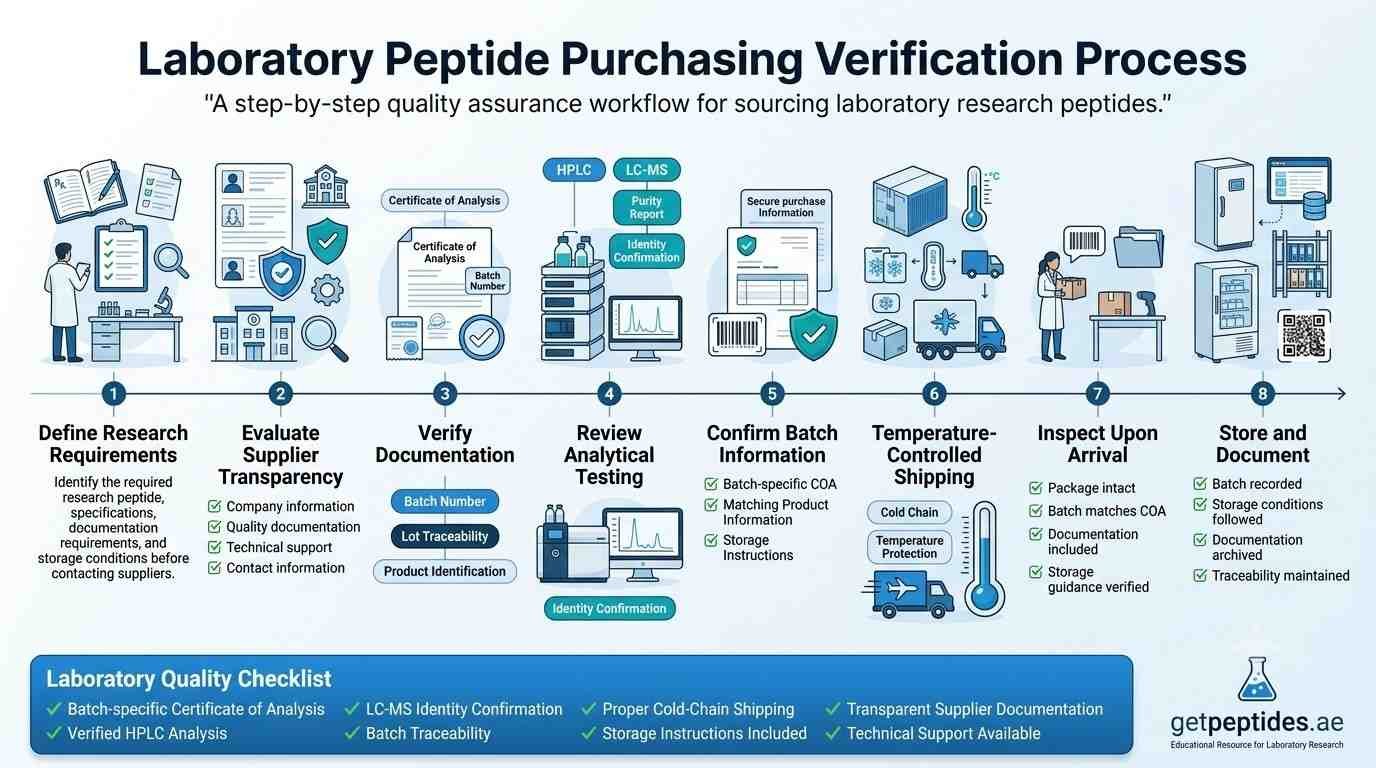
Cold-Chain Shipping Checklist
Before ordering, consider asking the supplier:
- Are temperature-sensitive products shipped using insulated packaging?
- Are storage recommendations included?
- Is shipment tracking available?
- How are delays handled?
- What packaging protects the materials during transit?
- How should products be stored immediately after delivery?
These questions help researchers evaluate logistics alongside analytical quality.
Mistake #5 — Choosing Suppliers Based Only on Price
Price is an important purchasing consideration, but it should never be the only factor used to evaluate a research peptide supplier.
A lower purchase price may appear attractive initially, yet additional costs can arise if documentation is incomplete, shipments require replacement, or quality records cannot support laboratory procurement requirements.
Experienced procurement teams typically evaluate the total value offered by a supplier rather than focusing solely on the invoice amount.
What Creates Long-Term Value?
Supplier value extends beyond the product itself.
Researchers should consider whether the supplier provides:
- Batch-specific documentation
- Responsive technical support
- Transparent analytical records
- Reliable shipping practices
- Clear storage guidance
- Consistent communication
These elements contribute to a smoother procurement process and reduce uncertainty during future orders.
Supplier Evaluation Matrix
| Evaluation Factor | Questions to Consider |
| Documentation | Is a batch-specific COA available? |
| Traceability | Can the batch be identified throughout the supply chain? |
| Analytical Testing | Are HPLC or LC-MS methods documented? |
| Shipping | Is appropriate packaging explained? |
| Communication | Are technical questions answered clearly? |
| Transparency | Are quality procedures openly described? |
Comparing suppliers using consistent criteria often produces better purchasing decisions than comparing price alone.
Mistake #6 — Ignoring Transparency
Transparency is one of the strongest indicators of a professional laboratory supplier.
Researchers should be able to understand:
- What documentation is available
- How products are identified
- Which analytical methods were used
- What storage recommendations apply
- How shipments are handled
- How technical questions are answered
Suppliers that openly explain their quality systems help researchers make informed procurement decisions.
Transparency also supports internal laboratory documentation by providing information that procurement teams can retain alongside purchasing records.
Signs of a Transparent Supplier
A transparent supplier typically provides:
- Clear product information
- Batch-specific documentation
- Storage guidance
- Shipping information
- Contact details
- Responsive customer support
- Educational resources explaining quality processes
Transparency is not about making broad claims—it is about making information available so researchers can evaluate it independently.
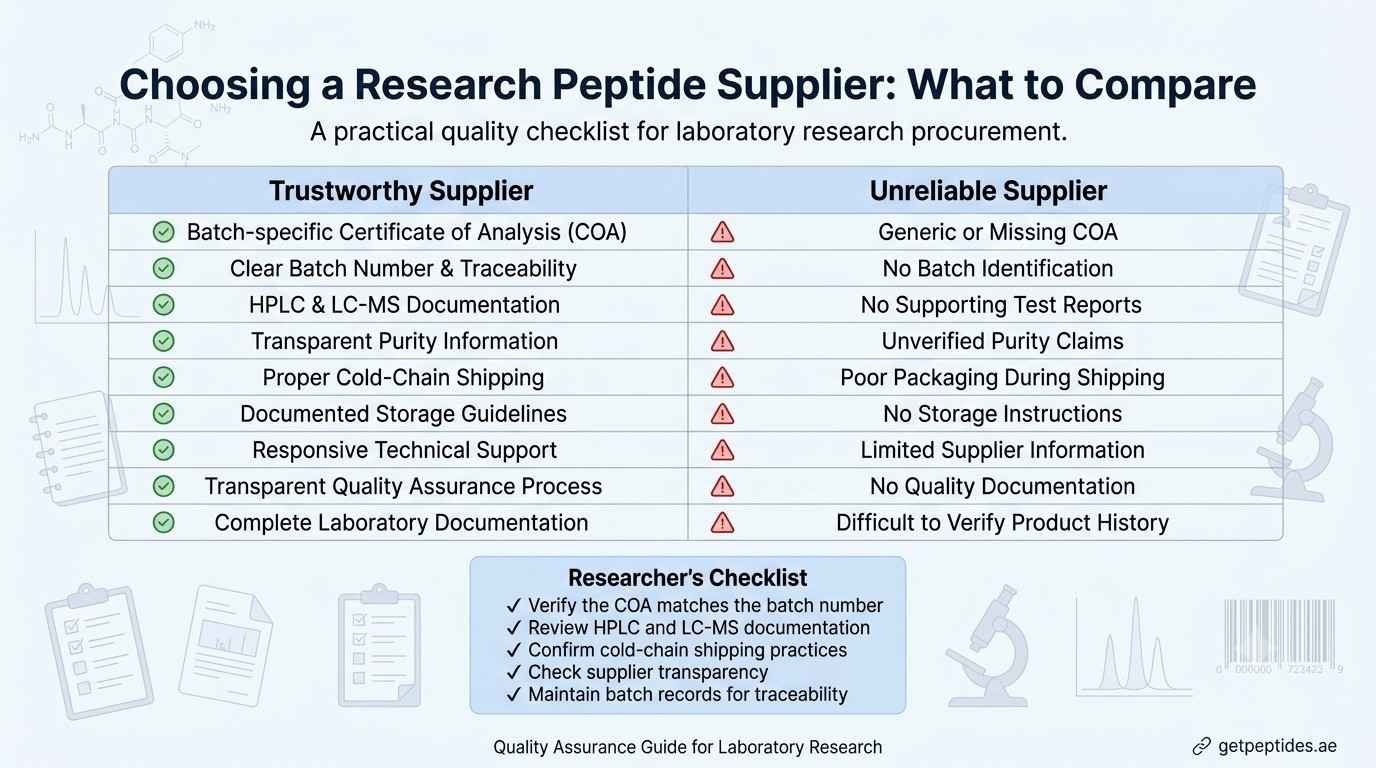
Reliable Supplier vs. Poor Supplier
| Quality Indicator | Reliable Supplier | Poor Supplier |
| Certificate of Analysis | Batch-specific and complete | Generic or unavailable |
| Batch Identification | Clearly documented | Missing or inconsistent |
| Purity Documentation | Supported by analytical methods | Marketing claims only |
| Shipping Information | Clearly explained | Little or no information |
| Storage Guidance | Included | Not provided |
| Technical Support | Answers documentation questions | Limited responses |
Questions to Ask Before Buying
A few well-chosen questions can reveal far more about a supplier than promotional material.
Before placing an order, consider asking:
- Is a batch-specific Certificate of Analysis available?
- Which analytical methods were used?
- Does the COA correspond to the supplied batch?
- How are products packaged during shipment?
- What storage conditions are recommended?
- Is batch traceability maintained?
- How are technical questions handled?
- Are analytical reports available for review?
- What information accompanies each shipment?
- How are shipping delays managed for temperature-sensitive products?
The quality of the answers often reflects the maturity of the supplier’s quality system.
Research Peptide Supplier Evaluation Checklist
Use the following checklist before placing an order.
Documentation
- Batch-specific Certificate of Analysis
- Product identification
- Batch or lot number
- Date of analysis
- Storage recommendations
Analytical Verification
- HPLC purity information
- LC-MS identity confirmation where applicable
- Clearly documented analytical methods
Shipping
- Appropriate protective packaging
- Temperature management explained
- Shipment tracking available
- Storage instructions upon delivery
Supplier Transparency
- Technical documentation available
- Responsive customer support
- Clear quality assurance information
- Transparent procurement policies
Completing this checklist before purchasing helps researchers evaluate suppliers consistently and reduces the likelihood of overlooking critical quality indicators.
Frequently Asked Questions
1. What should I check before buying peptides online?
Before purchasing laboratory research materials, review the supplier’s documentation rather than relying solely on product descriptions. At a minimum, verify that the supplier provides:
- A batch-specific Certificate of Analysis (COA)
- Batch or lot identification
- Analytical testing information (such as HPLC or LC-MS where applicable)
- Storage recommendations
- Shipping information
- Clear contact details for technical questions
These details help researchers evaluate transparency and support internal procurement documentation.
2. What is a Certificate of Analysis (COA)?
A Certificate of Analysis is a quality document that summarizes analytical information for a specific product or production batch. Depending on the supplier, it may include:
- Product identification
- Batch or lot number
- Date of analysis
- Analytical methods
- Purity results
- Laboratory information
Researchers should confirm that the COA corresponds to the actual batch supplied.
3. How do I know if a peptide supplier is legitimate?
A legitimate laboratory supplier is typically transparent about its quality processes. Indicators include:
- Batch-specific documentation
- Clear analytical reports
- Consistent product labeling
- Published storage guidance
- Professional customer support
- Readily available company information
Avoid making purchasing decisions based solely on advertising claims or pricing.
4. Why are batch numbers important?
Batch numbers allow researchers to trace a product back to a specific production run and its associated documentation.
This traceability supports:
- Procurement records
- Internal quality assurance
- Documentation consistency
- Repeat purchasing evaluations
5. What is HPLC purity?
High-Performance Liquid Chromatography (HPLC) is an analytical technique commonly used to estimate the purity of a sample by separating its components.
An HPLC purity result should always be interpreted together with the complete Certificate of Analysis and other supporting documentation.
6. What is LC-MS testing?
Liquid Chromatography-Mass Spectrometry (LC-MS) combines chromatographic separation with mass analysis to help confirm molecular identity.
When used alongside HPLC, it provides researchers with additional analytical information about a laboratory research material.
7. Why does cold-chain shipping matter?
Some laboratory research materials require controlled storage conditions to help maintain stability during transportation.
Appropriate shipping practices may include insulated packaging, temperature management, and clear storage instructions upon delivery.
Researchers should review shipping procedures before placing an order.
8. How should research peptides be stored?
Storage recommendations vary depending on the specific material.
Researchers should always follow the supplier’s documented storage guidance rather than relying on general advice.
Keeping original packaging, documentation, and batch identification together also supports traceability.
9. Can peptide purity vary between batches?
Different production batches may have different analytical results.
This is one reason batch-specific Certificates of Analysis are important.
Researchers should verify that the documentation corresponds to the exact batch received.
10. What documents should accompany research peptides?
Documentation may include:
- Certificate of Analysis
- Batch identification
- Product label
- Storage recommendations
- Shipping documentation where applicable
Maintaining these records supports laboratory quality systems.
11. What makes a trustworthy laboratory supplier?
Trustworthy suppliers typically demonstrate:
- Transparent documentation
- Batch traceability
- Clear analytical reports
- Professional communication
- Consistent quality procedures
- Educational resources explaining their quality standards
12. How can researchers identify questionable COAs?
Researchers should review whether the document includes:
- Batch number
- Product identification
- Date of analysis
- Analytical methods
- Laboratory information
Documents lacking these details may require additional clarification before procurement.
13. What happens if temperature-sensitive research materials experience shipping delays?
Shipping delays may increase exposure to varying environmental conditions.
Researchers should review the supplier’s packaging methods, shipping policies, and storage recommendations to understand how transportation is managed.
14. Why is traceability important?
Traceability connects laboratory materials to their production records, analytical testing, and procurement documentation.
This supports:
- Internal quality assurance
- Inventory management
- Repeat purchasing
- Procurement consistency
15. What information should a COA include?
A comprehensive Certificate of Analysis commonly contains:
- Product name
- Batch number
- Analytical methods
- Date of analysis
- Purity results
- Laboratory identification
The exact format may vary between laboratories.
16. How often should batches be tested?
Testing frequency depends on a supplier’s quality management procedures and manufacturing processes.
Researchers should focus on whether the supplied batch has corresponding analytical documentation rather than assuming testing schedules are identical across suppliers.
17. What packaging helps protect laboratory research materials during shipping?
Appropriate packaging may include:
- Protective containers
- Insulated packaging where required
- Secure labeling
- Moisture protection where appropriate
- Documentation enclosed separately or digitally
Packaging should support safe transportation and clear product identification.
18. Why do suppliers provide batch numbers?
Batch numbers allow each production run to be identified independently.
They help connect products with:
- Certificates of Analysis
- Analytical testing
- Inventory records
- Procurement documentation
19. What is lot traceability?
Lot traceability refers to the ability to follow a product through its production, documentation, storage, and distribution records.
It supports consistent procurement practices and laboratory documentation.
20. What questions should researchers ask before ordering?
Before placing an order, consider asking:
- Is the COA batch-specific?
- Which analytical methods were used?
- How are products shipped?
- What storage conditions are recommended?
- Is batch traceability maintained?
- What documentation accompanies the shipment?
Clear answers help researchers evaluate supplier transparency before procurement.
Conclusion
Purchasing research peptides involves far more than comparing product listings or prices. A well-informed procurement process begins with verifying objective quality indicators that support laboratory documentation and traceability.
Throughout this guide, we’ve covered the common mistakes when buying peptides online, including:
- Accepting Certificates of Analysis without verification
- Overlooking batch traceability
- Relying on unsupported purity claims
- Ignoring cold-chain shipping practices
- Selecting suppliers based only on price
- Overlooking supplier transparency
Each of these areas plays a role in responsible laboratory procurement.
By reviewing documentation, confirming batch-specific analytical reports, understanding testing methods such as HPLC and LC-MS, and evaluating shipping and storage practices, researchers can make more informed purchasing decisions based on verifiable information rather than marketing claims.
A structured supplier evaluation process also supports internal quality assurance and helps maintain consistent procurement standards across future projects.